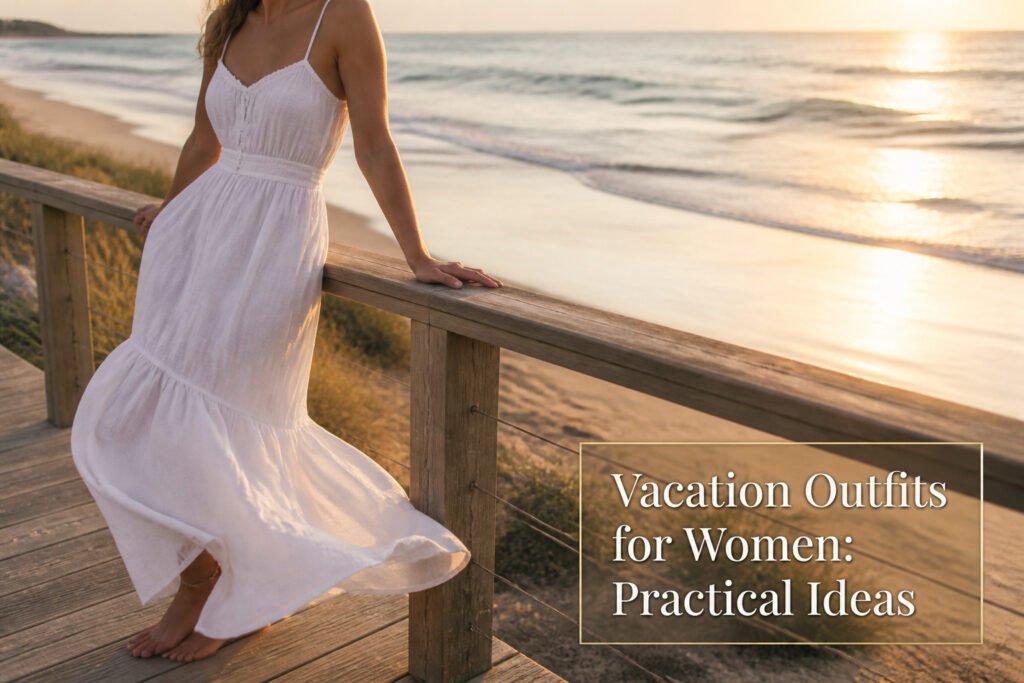
The right vacation outfit for women handles a full day without a change; the wrong one strands you at the beach. Fabric separates the two: cotton and linen breathe through humid afternoons, while cheap rayon pills after two wears and holds sweat odors. A sundress with straps wide enough to hide a standard bra, or a bodice structured enough to skip one entirely, saves you from the special-bra mistake that keeps dresses in suitcases.
1. Sundresses That Carry a Whole Day

Sundresses earn their spot as the most-packed vacation piece because one garment replaces three. Three out of five competing roundups name them first, and the reason is practical: the right sundress handles morning market walks, afternoon museum stops, and dinner reservations without a change. The wrong one strands you at the beach.
Fabric separates the two. Cotton and linen breathe through humid afternoons and soften with washing, though linen wrinkles the second you sit. Rayon drapes well and dries fast after a sink rinse, but cheap versions pill after two wears and hold sweat odors. The cut matters more than the print. A defined waist or adjustable tie lets you hike the hem for walking and drop it for evening. Straps wide enough to hide a standard bra, or a bodice structured enough to skip one entirely, save you from the special-bra mistake I have watched friends make repeatedly: they pack a backless sundress, realize too late it requires adhesive cups or a strapless converter, and spend the vacation tugging at something that quits by lunch. A dress that needs equipment you do not already own is a dress that stays in the suitcase.
2. Swimwear You Actually Move In

The swimsuit that looks incredible on the hotel balcony usually quits around hour two of actual motion. Straps dig, seams creep, and that delicate crossover detail you loved in the mirror turns into a constant readjustment project once you’re actually swimming, snorkeling, or sprinting after a three-year-old who spotted a crab. Fabric recovery matters more than the tag price: a suit that bounces back after salt water or chlorine keeps its shape through a week of real use, while one that bags out by day three becomes a reluctant cover-up itself.
A good cover-up earns its luggage space by handling the transition without a full change. Something that dries fast enough to walk straight from the pool edge to a lunch table, that doesn’t look like you grabbed a bedsheet, saves you the locker-room line and the extra outfit in your day bag. The best ones read as intentional enough for a restaurant and functional enough that you don’t mind if they get splashed.
3. Shorts and Tanks for Real Walking

Three-inch inseams look cute in the hotel mirror and then betray you by day three of heavy walking, when the inner-thigh rub turns every step into a negotiation. I now pack shorts with at least a five-inch inseam for any trip that involves real mileage, and I look for fabric with enough weight to keep its shape rather than bunching or showing dampness where it should not. Denim shorts fail this test completely in humid climates; the cotton holds moisture, the seams stiffen, and by mid-afternoon you are carrying wet cardboard against your skin.
For sandals, a cross-strap leather footbed with actual arch support will carry you through a full day of cobblestones without drama. The ones that blister by noon are usually the flat, thin-soled slides with a single strap across the toes: no structure, no give, and your foot slides around until the skin gives up. I have learned to test-walk any pair for at least two hours at home before they make the suitcase cut.
4. Maxi Skirts From Beach to Dinner
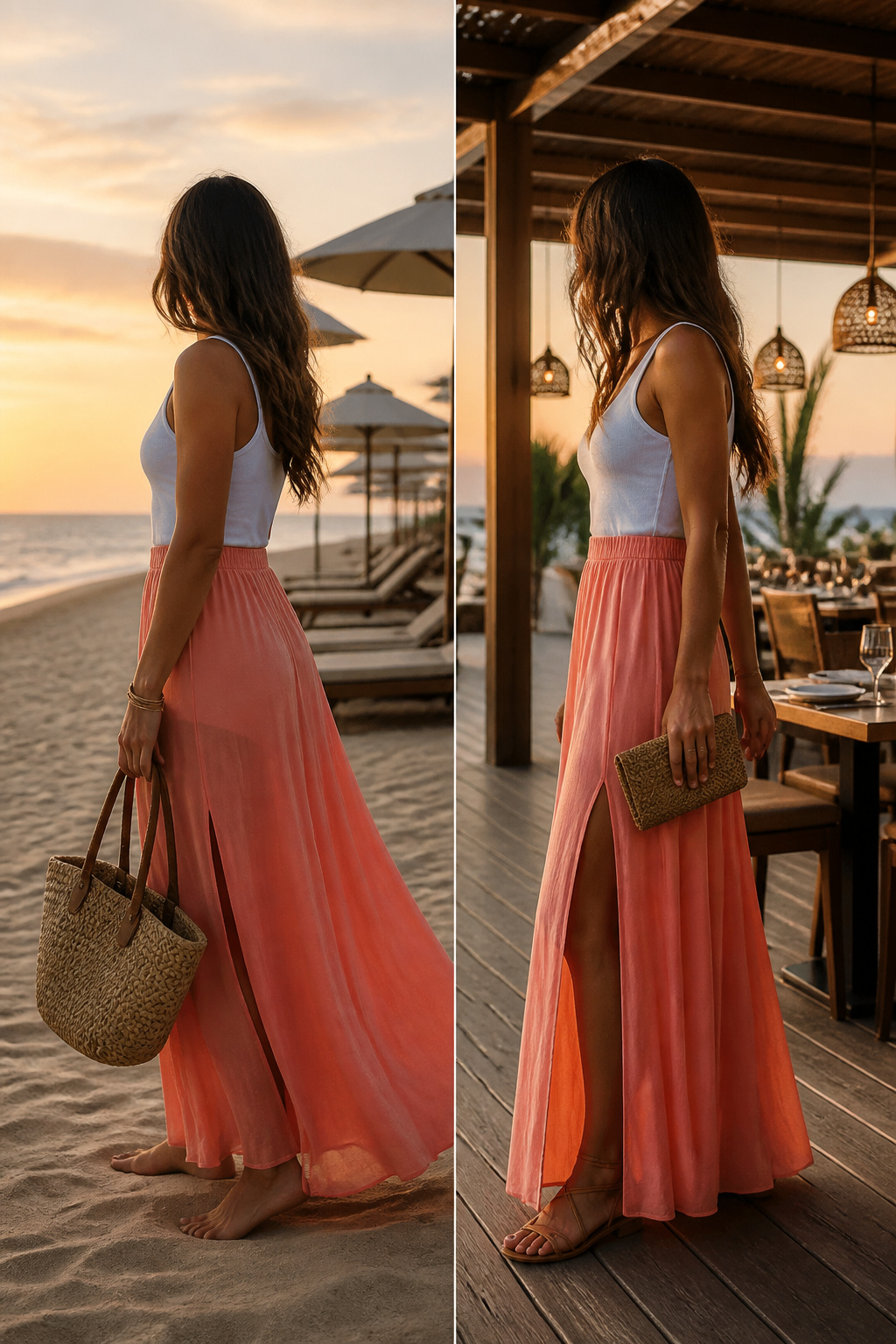
A maxi skirt earns its luggage space only if it can pass inspection at a restaurant after a morning on the sand. The difference between beach cover-up and dinner-appropriate comes down to three things: fabric weight, waistband structure, and slit placement. A skirt in something with body, like a cotton poplin or light linen blend, holds its shape instead of clinging. A defined waistband, especially one that sits at the natural waist, reads intentional; an elastic or drawstring waist looks like you threw it on over a suit. Slit placement matters too. A center-front or side slit that opens to mid-thigh while walking gives movement without full exposure; a skirt with no slit can look matronly, while one slit to the hip stays beach-only.
The shoe change is what actually moves the outfit across the line. Flat leather sandals keep things casual for daytime; swapping in a low block heel, even a modest one-inch version, lifts the hemline visually and changes your posture enough that the same skirt registers as dressed-up.
Packing math on this is clean: one skirt, three tops, three occasions. A fitted tank for morning coffee, a tucked-in button-down for gallery walking, and a sleeveless silk or crepe blouse for dinner. The skirt does the heavy lifting; the tops just signal which version of the day you’re in.
5. Rompers and the Bathroom Problem

Rompers look like the easiest win in vacation packing: one piece, instant outfit, done. The reality hits somewhere around the second public restroom visit, when you’re fully undressed in a stall with your clothes pooled around your ankles and your bag hanging from the hook by its last thread. For anyone with a long torso or a long rise, the fit fight is worse; standard inseams ride up, waistbands hit at the wrong rib, and the whole thing starts feeling like a baby onesie with ambition.
Button-front and wrap styles change the math. A full placket or a true wrap means you only unfasten what you need, not the entire garment. Elastic-waist shorts versions separate the top from the bottom just enough to solve the stall problem without losing the one-piece simplicity. These are the versions worth the hanger space.
A standard romper still earns its place on trips where you’re moving from pool to patio and bathroom privacy isn’t an issue, or when the day is short enough that the inconvenience stays theoretical. For city walking, museum days, or any itinerary with unpredictable facilities, the modified cuts win.
6. The Sandals That Last the Trip

A vacation wardrobe lives or dies at the feet, and sandals are where most of us miscalculate. Three distinct jobs exist: the flat leather walker with real arch support for cobblestone days, the sport sandal that handles water and uneven terrain, and the dress sandal that only works for dinner. One pair never covers all three, and pretending otherwise is how you end up with blisters in a port town or clunky soles at a waterfront restaurant.
The break-in period is the math nobody does. Leather walkers need roughly five to ten wears before the straps soften and the footbed molds, which means they sit in the closet for weeks before departure. Sport sandals break in faster but look it, and the dress sandal that feels fine at home often pinches by the third course. Packing two functional categories plus the dinner option sounds excessive until you calculate the cost of a ruined afternoon limping back to the hotel.
My own tendency is to overinvest in the pretty pair and underfund the walker. The correction that actually worked: buying the leather walkers first, wearing them on everyday errands until they disappear on the foot, then adding the others around that baseline.
7. Sun Hats That Stay On

A sun hat earns its spot in your bag only if it still sits on your head when the ferry picks up speed. The wide-brimmed straw that photographs beautifully at brunch becomes a liability the moment you step onto a boat deck; the underside of that brim catches wind like a sail and either lifts straight off or snaps the neck strap hard enough to leave a mark. A brim under four inches, or one with a wired edge you can angle downward, solves this without making you look like you’re tending a garden.
Packable straw sounds ideal until you unpack it. The weave meant to fold into a suitcase often rebounds with creases that break the fibers, and a crushed crown never regains its shape. Paper braid and raffia hold up better to being rolled, though they still need a gentle steam in a hotel bathroom before they look intentional rather than rescued.
The chin strap is the feature most women resist and most end up grateful for. On a bike rental, a paddleboard, or even a windy clifftop walk, it keeps the hat with you instead of in the water. Look for one that detaches or tucks into the band; you’ll wear it when you need it and hide it when you don’t.
For actual protection, the numbers matter more than the style. A UPF 50+ rating blocks roughly 98 percent of UV, while unlabeled straw leaves gaps in the weave that let light through. Brim width determines whether your neck and ears stay shaded: three inches covers the face, but four to five inches is what actually casts shade on your neck when the sun is high. The crown should sit snug enough not to shift in a gust, loose enough that you don’t get a headache by noon.
8. The One Light Layer for Cold Rooms and Cool Evenings

The travel layer fails in three predictable ways: too heavy to carry through a hot afternoon, too thin to stop a real breeze, or too structured to crush into a tote without looking like you slept in it. What convinced me, reading through how these pieces actually perform, is that merino around 150 gsm or a cotton-linen knit with some body to it solves the weight problem without becoming dead weight in the bag.
A boyfriend cardigan in that mid-weight knit, or a shirt-jacket cut from unlined chambray or a very light wool, gives you structure you can roll small. The trick is the construction: no lining, no heavy seams, no buttons that dig when compressed. I would skip anything labeled "blazer" unless it explicitly says unlined; those half-lined summer jackets look crisp for exactly one hour, then become the thing you are stuck carrying.
Color matters more here than in almost any other piece you pack. The layer you reach for at 6 pm over a sundress, then again at dinner over a tank, then the next morning for coffee, needs to not fight anything. Warm white, stone, or a soft camel goes with prints and solids alike without the heaviness of black or the stain-magnet problem of true white. One layer, three weights of evening, no extra bag required.
What Breathable Actually Means on a Tag

A tag that says "breathable" usually means the fabric lets air pass through, but the word itself has no legal definition. Cotton and linen actually do this because their fibers are hollow and the weave leaves tiny gaps. Linen becomes see-through around 130 grams per square meter, so a 150 gsm dress holds its structure while a 120 gsm blouse needs a slip underneath.
Cotton’s breathability depends on the weave, not just the fiber. A loose, open weave like seersucker or gauze dries overnight in humid air because the threads do not pack tight enough to trap moisture. A tight satin weave, even in 100% cotton, stays damp against the skin for hours because the surface is nearly sealed.
Marketing often calls polyester "breathable" when it is really just perforated or chemically treated to wick sweat away from the body. That works for the first day. By the second day of a trip, the same treatment traps odor molecules that cotton and linen release in the wash. A 5% spandex blend in a "performance" top makes the problem worse; the elastic fibers create pockets where bacteria sit.
Colors That Read Vacation Instead of Laundry Day

Light colors do the heavy lifting on vacation because they reflect heat and show up against water, sand, or stone in a way that reads as intentional rather than leftover from a work trip. I used to pack white and navy for a tropical week, thinking I was being smart and classic, and ended up looking like I had wandered off a yacht I didn’t own. The navy went heavy in photographs; the white went sheer where I sweated through it. Neither looked relaxed.
Florals work when the scale matches the setting: a palm print the size of your hand reads costume on a petite frame, while a tiny ditzy floral on a maxi skirt just reads busy. The mistake is treating vacation as permission to wear every bright thing at once. One strong piece, a solid ground, and you’re dressed for the place instead of performing it.
Black in direct sun photographs flat and featureless, swallowing the texture that makes linen or cotton look expensive. I still pack one black tank for evenings, but I know it will look better in person than in any photo I try to take. The color that reads vacation is the one you don’t have to think about once you’re wearing it.
The Mix-and-Math for a Carry-On

The math only works if every piece talks to at least two others. I learned this the hard way on a five-day trip to Charleston where I packed a printed midi skirt that clashed with every top except one plain white tee. That skirt ate suitcase space and delivered a single outfit.
The 8/12 rule is what saves you: eight pieces making twelve outfits. Two bottoms, three tops that all match both, one dress, one light layer, and one pair of shoes that handles walking and a nicer dinner. Each top must work with each bottom. The dress stands alone but the layer goes over it. That is your dozen looks right there.
Shoes are where the ratio breaks. Two pairs is the practical ceiling for a carry-on, yet most of us pack three or four "just in case." The case never comes. One pair of leather sandals with a cushioned footbed and a low block heel covers ninety percent of vacation ground. The second pair should be something you can swim or hike in, depending on the trip. Everything else is weight you carry through airports for no reason.
Accessories That Earn Their Weight
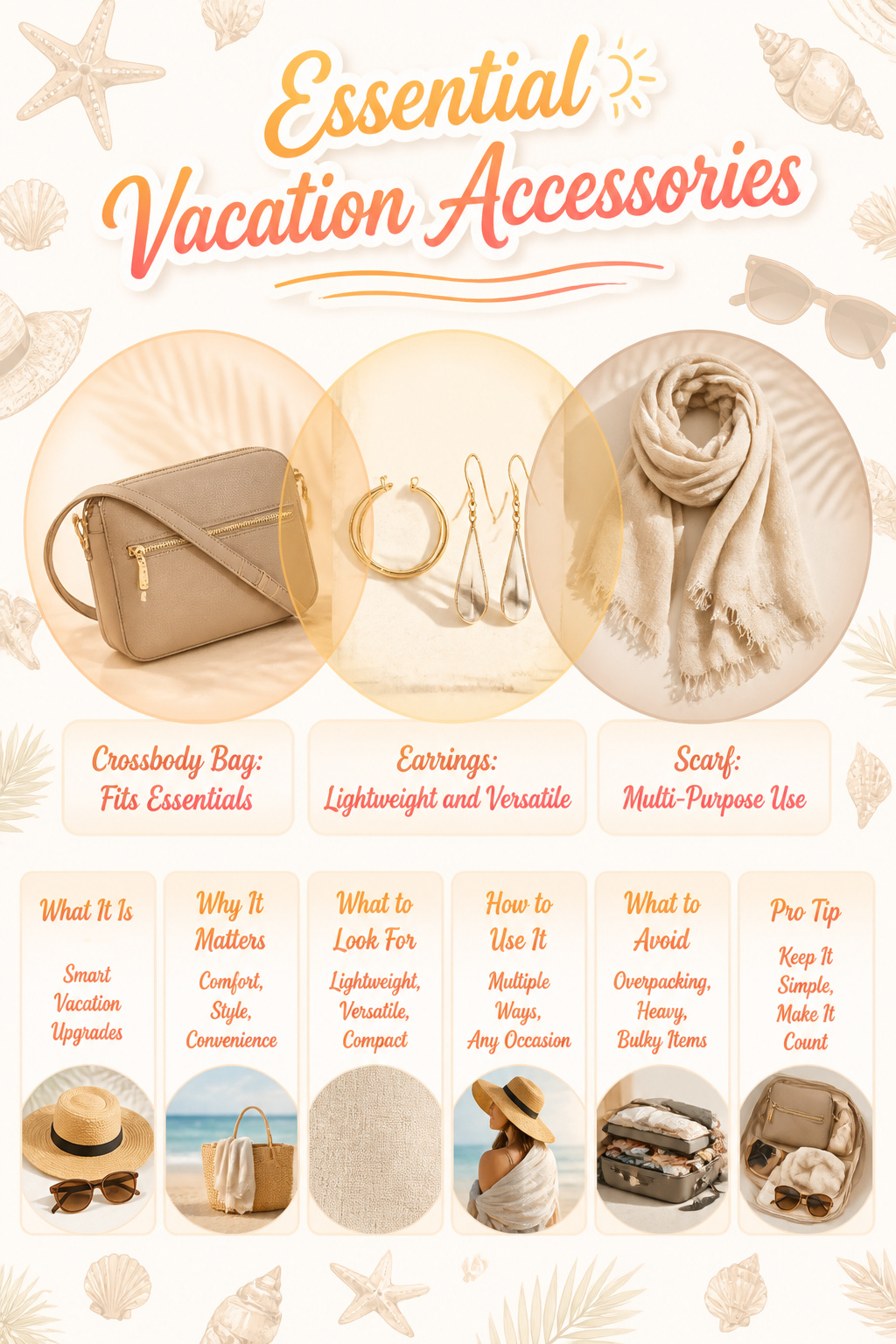
The accessory advice in most vacation outfit roundups stops at "bring sunglasses and a crossbody bag," which leaves you digging for your room key while the line backs up behind you. A crossbody bag with one zip compartment that fits phone, sunscreen, and key card flat solves that; anything larger and you will leave it at the hotel. I look for a strap that adjusts short enough to sit at the high hip, not the thigh, so the bag stays put on a bike or a boat.
Earrings are where I used to overpack. Now I take one pair that works with both the sundress and the maxi skirt: small hoops or a thin drop in gold or silver, nothing that clashes with warm or cool tones. The weight matters more than the price; lightweight metal or resin keeps the holes from stretching after a week of salt and sweat.
A large cotton or linen scarf earns its space three times over. Morning sun cover on the walk to breakfast, plane blanket when the AC blows too cold, evening wrap when the restaurant opens the windows. The trick is the fabric: open weave breathes, tight weave drapes like a shawl. I keep one in natural white or sand so it reads intentional, not leftover, in every setting.
Frequently Asked Questions
What are the best outfits for a beach vacation?
The best vacation outfits for women center on pieces that handle multiple settings without a full change. A sundress in cotton or linen with a defined waist moves from morning markets to dinner reservations, while a maxi skirt in cotton poplin or a light linen blend transitions from sand to restaurant with just a shoe swap. Swimwear needs fabric recovery that bounces back after salt water, paired with a cover-up that dries fast enough to walk straight to lunch.
How do I pack for a vacation?
Follow the 8/12 rule: eight pieces that create twelve outfits. Pack two bottoms, three tops that match both, one dress, one light layer, and one pair of shoes that handles walking and nicer dinners. Every top must work with every bottom, and the dress stands alone while the layer goes over it. Limit yourself to two pairs of shoes total; anything beyond that is weight you carry through airports for no reason.
What should I wear for sightseeing?
For real walking, choose shorts with at least a five-inch inseam and fabric with enough weight to keep its shape rather than bunching. Skip denim in humid climates; it holds moisture and stiffens by mid-afternoon. Pair with a cross-strap leather sandal that has actual arch support, and test-walk any pair for at least two hours at home before packing. A breathable tank in loose cotton weave like seersucker or gauze dries overnight even in humid air.