
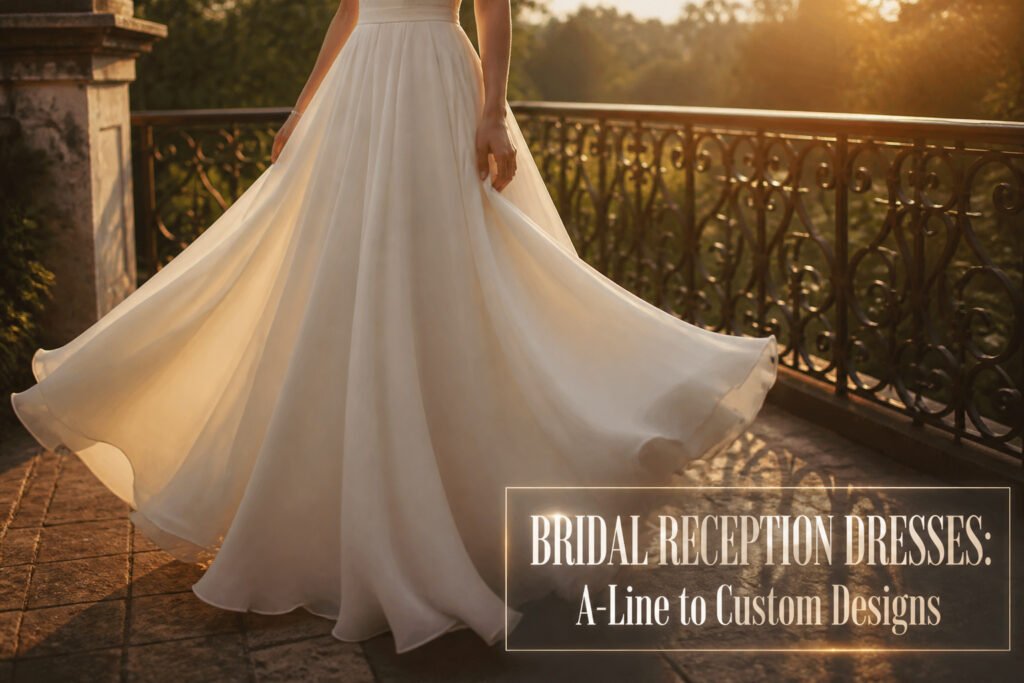
A bridal reception dress is the outfit you change into after the ceremony, built for sitting, dancing, and moving through a crowd rather than standing at an altar. The catch is that silhouette and fabric matter more than they do for the main gown, because you will wear this piece for longer and photograph less formally. A-line cuts dominate actual roundups for a reason: the flare from the natural waist forgives nearly every body shape without the constant adjustment that narrower or fuller shapes demand.
A-Line Dresses
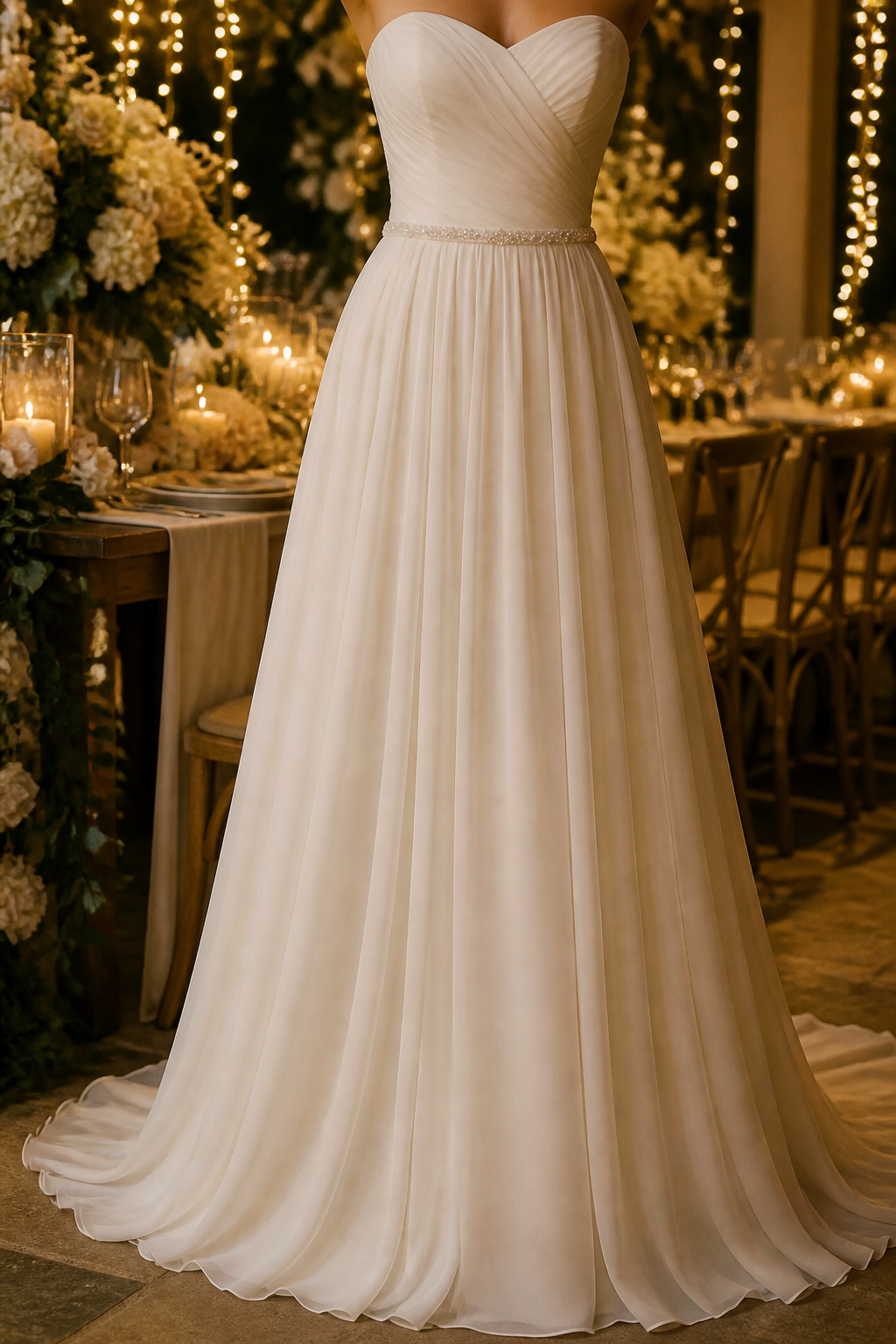
An A-line skirt flares gently from the waist without clinging to hips or thighs, which makes the silhouette forgiving across nearly every body shape. The cut leaves room to sit, dance, and move through a long reception without the constant adjustment that narrower shapes demand.
The waist definition matters most. A well-placed seam or belt line sits at the natural waist, not dropped toward the hips, or the whole proportion shifts wrong. I’ve seen this mistake at two weddings now: the bride looked boxy because the waistline fell an inch too low, and the dress that should have skimmed instead hung.
Fabric weight changes everything. Stiff organza holds the A shape like architecture; soft chiffon collapses toward the body and reads almost like a sheath in motion. For an evening reception, the lighter drape photographs better but needs a structured underlayer to keep the line clean.
Three separate roundups of bridal reception dresses name A-line as the most recommended shape, and the consistency surprised me reading through them. The reason given each time is the same: it works without tailoring drama for bodies that carry weight in the midsection, the hips, or neither.
Ball Gowns
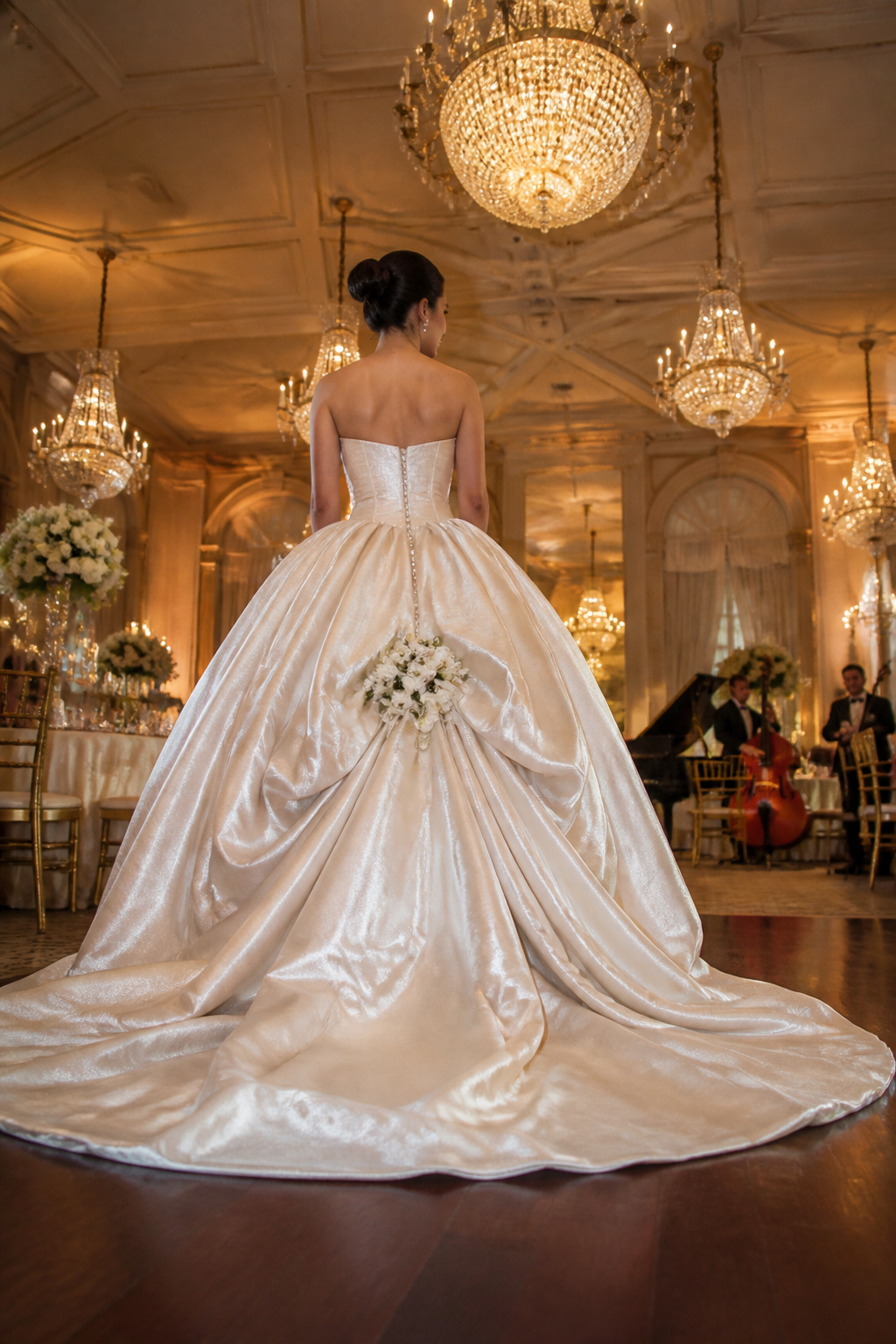
A ball gown at the reception only makes sense when the party itself is the main event. I have watched brides stand in receiving lines for three hundred guests, then lead a full waltz onto a floor that was built for one. That volume of skirt, the structured bodice, the train that needs bustling: it all works if the room has twenty-foot ceilings, a live band, and a timeline that gives you more than forty minutes to dance.
The mistake is carrying ceremony gravity into a cocktail-style party. One bride I planned with insisted on her cathedral-length gown for a rooftop lounge with high-tops and passed appetizers. She spent the night trapped at the head table because the skirt would not clear the bench seating. The gown had been perfect for the church; at the reception, it read as costume, not celebration.
Fabric weight matters more than silhouette here. Taffeta and brocade hold the shape that makes a ball gown register as formal, but they also trap heat under chandeliers and against bodies on a packed floor. Organza layers give the same visual drama with less mass, and a reception in a ballroom with air conditioning that actually works can handle either. The setting dictates the choice: grand staircase for entrance photos, assigned seating with space between tables, and a first dance that is choreographed rather than swaying. Without at least two of those three, the gown becomes furniture you are wearing.
Sheath Dresses

A sheath dress skims the body from shoulder to hem without flare, giving bridal reception dresses a clean, uninterrupted line that reads modern against the fussier alternatives. The cut sits close but not tight, usually with minimal waist definition, so the fabric itself does the work. Silk crepe or heavy satin holds the shape best; anything too lightweight will cling where you do not want it to.
This silhouette favors straighter frames and smaller busts, since curves have nowhere to hide and a defined waist is not built in. I have watched hourglass figures struggle with the pull across hips that leaves gaping at the back waist, a problem a-line cuts simply do not have. For reception styles, sheath dresses suit city venues, cocktail-hour timelines, and any bride who plans to move through a crowd rather than pose in one spot. The hem typically hits at or just below the knee, which keeps it practical for dancing without the costume drama of a floor-length change.
Mermaid Dresses
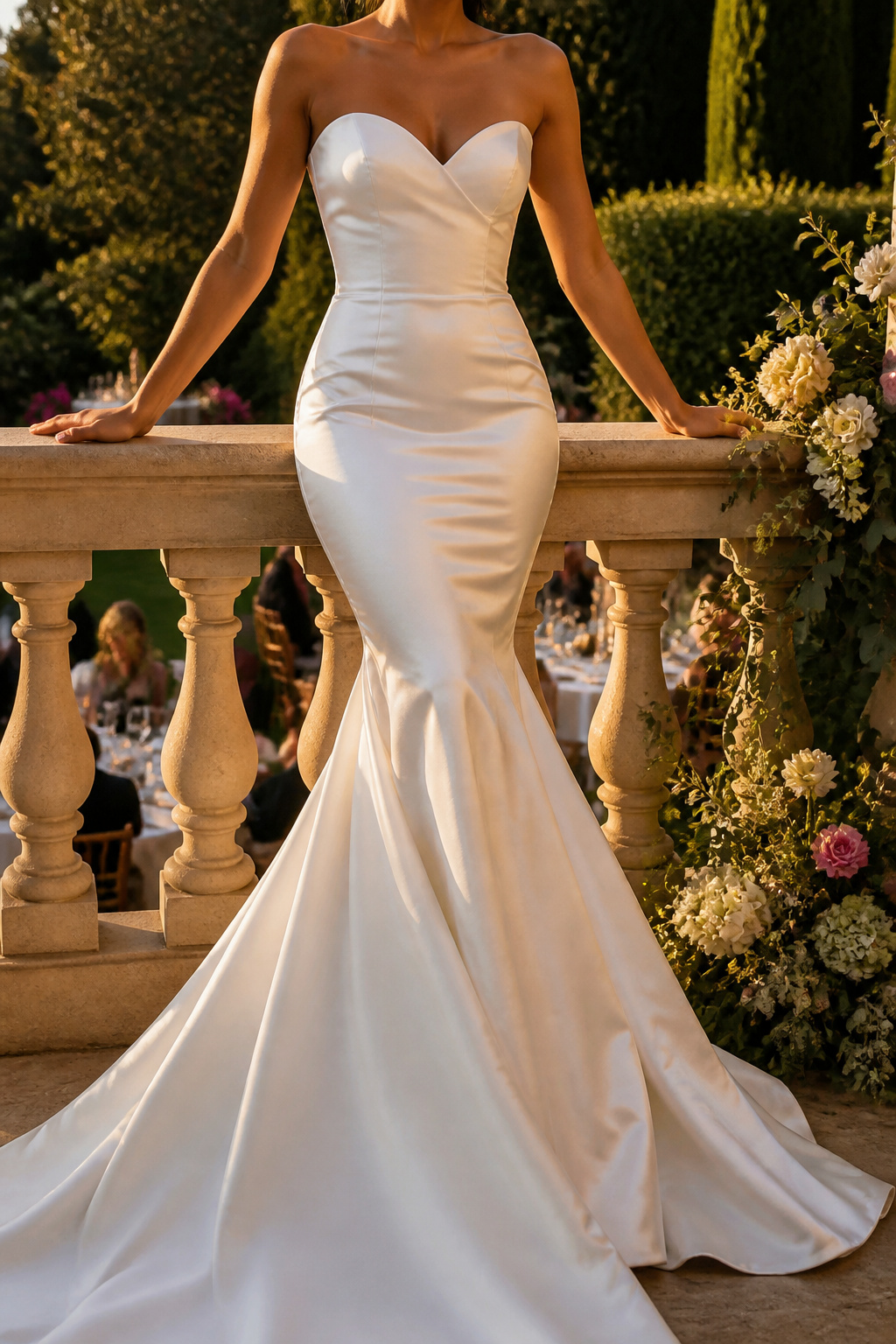
A mermaid silhouette hugs the body through the torso and hips, then flares dramatically at or below the knee. That late flare is what sets it apart from a trumpet or fit-and-flare; the line stays tight longer, so the effect is more sculpted, more overtly dramatic. Brides who want to emphasize curves rather than soften them tend to gravitate here. The shape does the work of structure and statement at once.
The fit demands precision. Because the fabric is fitted through the hips and thighs, any gap or pull reads instantly; alterations are nearly always necessary to get that seam sitting exactly at the knee break. Movement matters too. The skirt restricts stride length, so walking, sitting, and dancing require some planning. A bride who wants to float across the reception floor unbothered may find herself managing the dress more than wearing it.
That said, for the right body and the right evening, the mermaid silhouette delivers something specific: presence without volume. It reads confident, intentional, slightly old-Hollywood. Women with balanced proportions, hourglass or pear shapes, often find the cut validates what they already have rather than reshaping it. The dress does not disguise; it announces.
Tea-Length Dresses
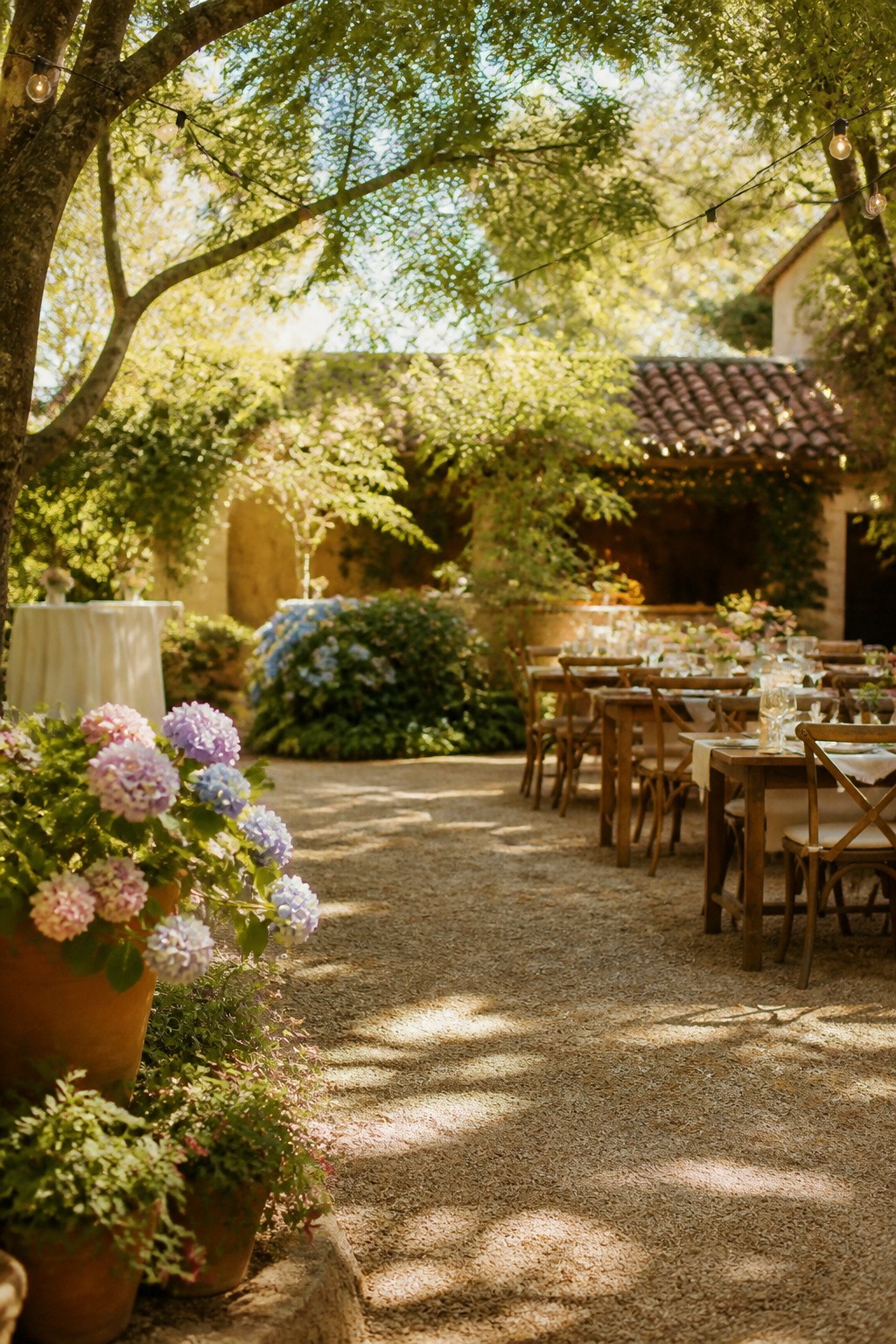
A tea-length dress hits somewhere between the bottom of the calf and the ankle, a cut that reads as playful without tipping into costume territory. For a casual reception, this length lets you move through a garden party or a restaurant back room without the train anxiety that comes with floor-length gowns. The exposed ankle also happens to be one of the more forgiving visual breaks for petites; the proportion keeps legs looking longer than a midi that chops at the widest part of the shin.
I would skip this length for any reception with a formal dress code or a seated dinner where the hem floats awkwardly above chair level. It works best when the setting has some air to it: outdoor cocktails, a late-afternoon terrace, anywhere guests are standing more than sitting. Pair it with a heel that has some substance; a delicate stiletto underneath all that volume looks like an afterthought, but a block heel or modest wedge anchors the silhouette properly.
Bohemian Styles
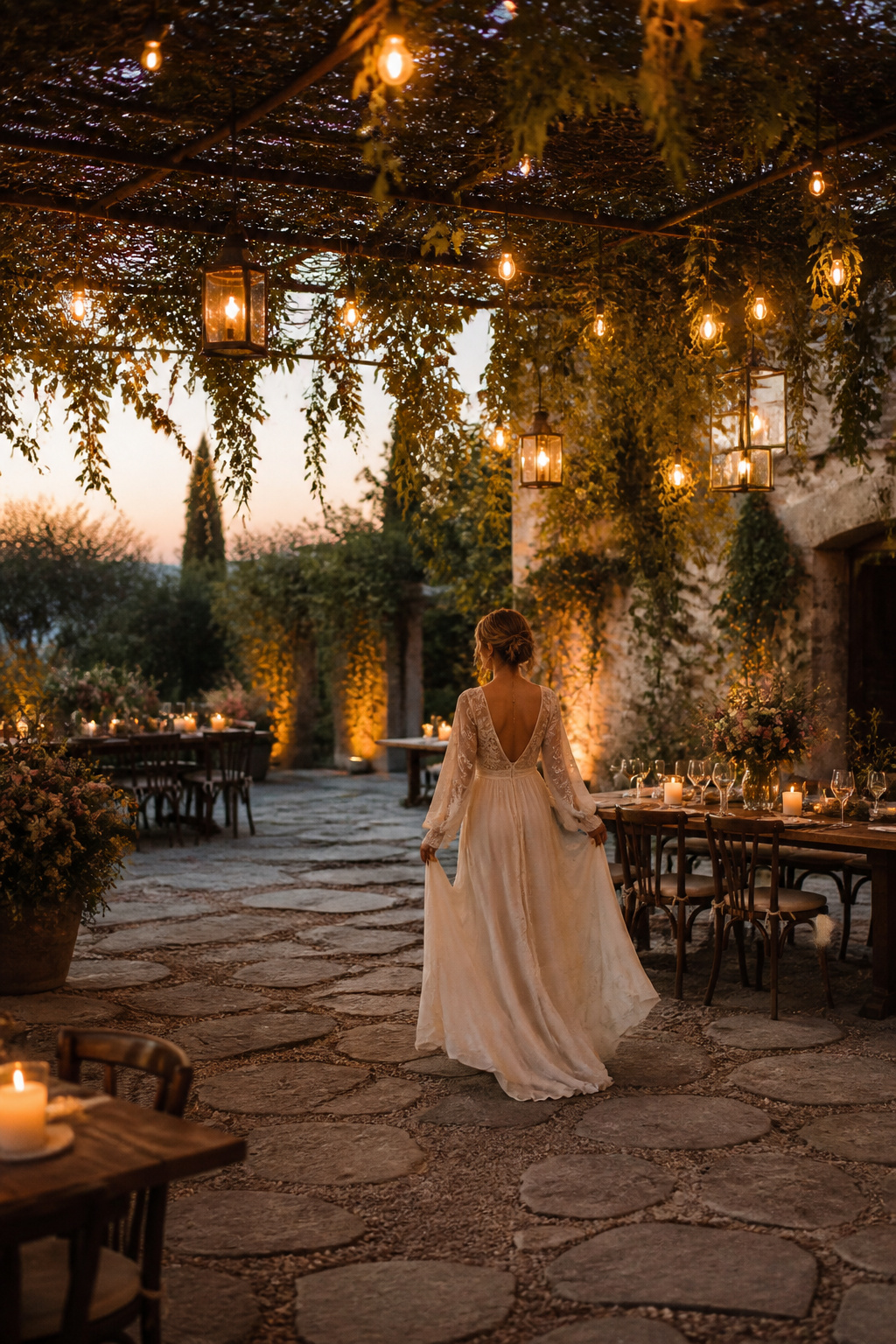
Flowing fabrics and relaxed fits sit at the heart of bohemian bridal reception dresses, a style that trades structure for movement. Chiffon, gauzy cotton, and soft lace drape rather than cling, with empire waists, flutter sleeves, and trailing hemlines that read effortless rather than undone. The aesthetic borrows from vintage festival wear: muted earth tones, botanical embroidery, or delicate crochet trim, always with enough ease that dancing until midnight feels assumed, not assumed-away.
This look finds its footing in outdoor venues. Vineyards, barns, beachfront tents, and garden estates all suit the unpretentious silhouette; a grand hotel ballroom tends to swallow it. The bride who leans this way usually wants to kick off her heels by the cake cutting and has probably already chosen wildflower arrangements over formal centerpieces. She may wear her hair down, or she may not, but the dress itself should look like it could survive a breeze without drama.
Plus-Size Options
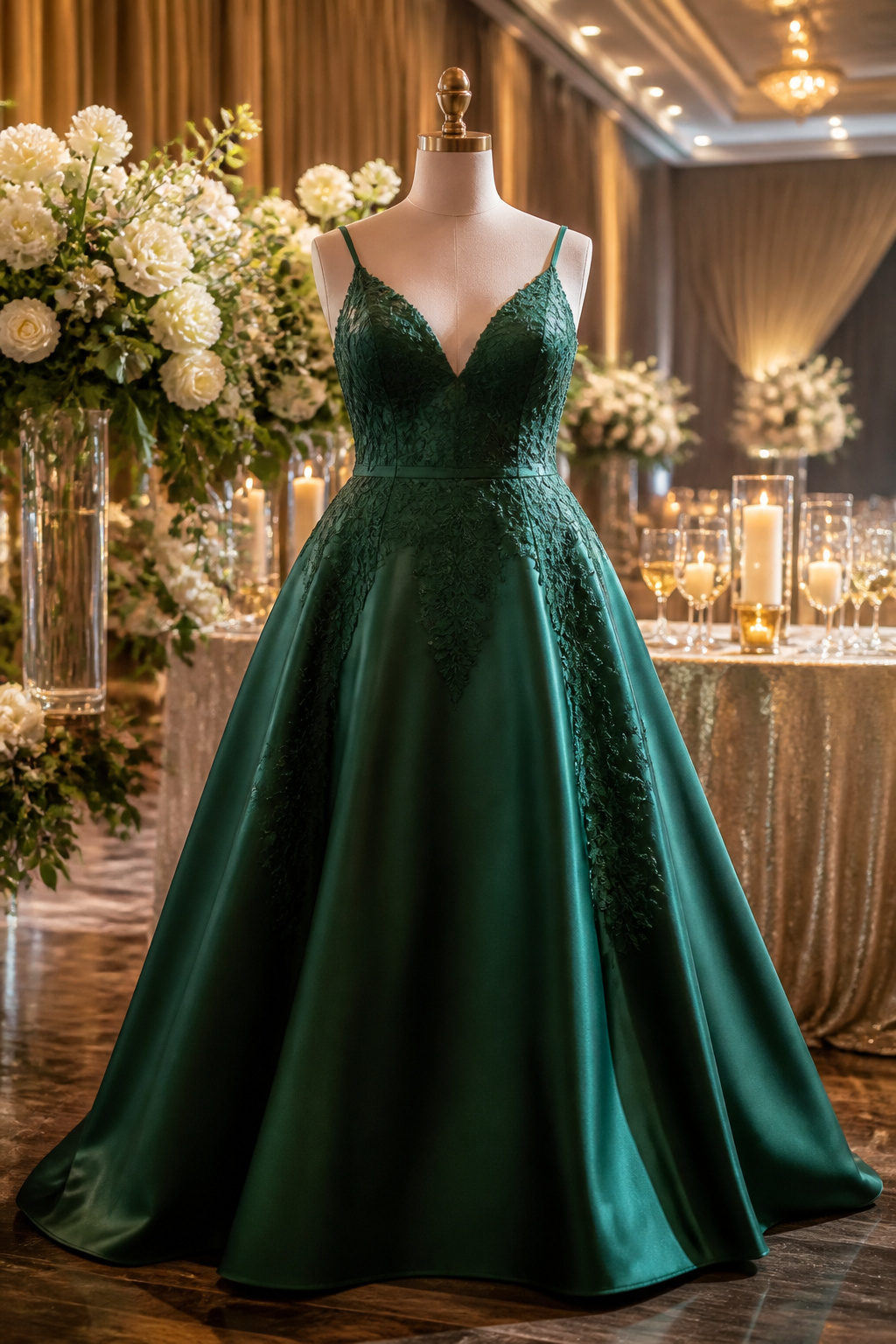
The market for plus-size bridal reception dresses has shifted noticeably in the last five years, with more designers building above a size 16 from the first sketch rather than scaling up later. What convinced me, reading through a dozen of these collections, is that the difference shows up most in the waist. A bodice graded up from a smaller block tends to flatten curves or gap at the back; one drafted for a fuller midsection carries the weight differently and sits still while you move.
For silhouette, the A-line still wins for the widest range of bodies because the flare starts at the natural waist and skims rather than clings. An empire waist can work, but only if the seam sits truly beneath the bust and not on it; otherwise the whole dress rides up when you raise your arms for a toast. Fit-and-flare styles demand careful attention to the hip line. The flare must begin low enough that the skirt does not balloon from the widest point, which adds visual width rather than shape.
Fabric matters as much as cut. Matte crepe and structured satin hold a line without bulk, while thin jersey or clingy chiffon show every undergarment seam. If you are ordering online, check whether the brand lists a finished garment measurement for the waist and hip, not just a size chart. The best ones do, and the half-inch difference between their size 18 and another’s size 18 is usually the difference between a dress that needs tailoring and one that does not.
Custom Designs

A custom bridal reception dress lets you control what standard sizing usually decides for you. Most brides start with the neckline, since that frames every photo from the evening, then adjust the sleeve length or eliminate sleeves entirely based on the season and venue. Train length is another common change; a full ceremony gown might need a bustle or removal for dancing, while a reception-specific design can skip the train from the start.
The process typically begins with a consultation where you bring reference images and describe your movement needs for the evening. A sketch follows, then a muslin fitting to test the structure before any expensive fabric is cut. Plan at least four to six months for this back-and-forth, and budget roughly 30 to 50 percent above an equivalent off-the-rack piece. The tradeoff is real: you get a dress that sits exactly where you want on your shoulders and waist, but you are also the quality-control step. If the bodice gap that plagues your usual size is solved here, the hours of fitting room frustration you skip can feel worth the wait.
Choosing for Your Body Type
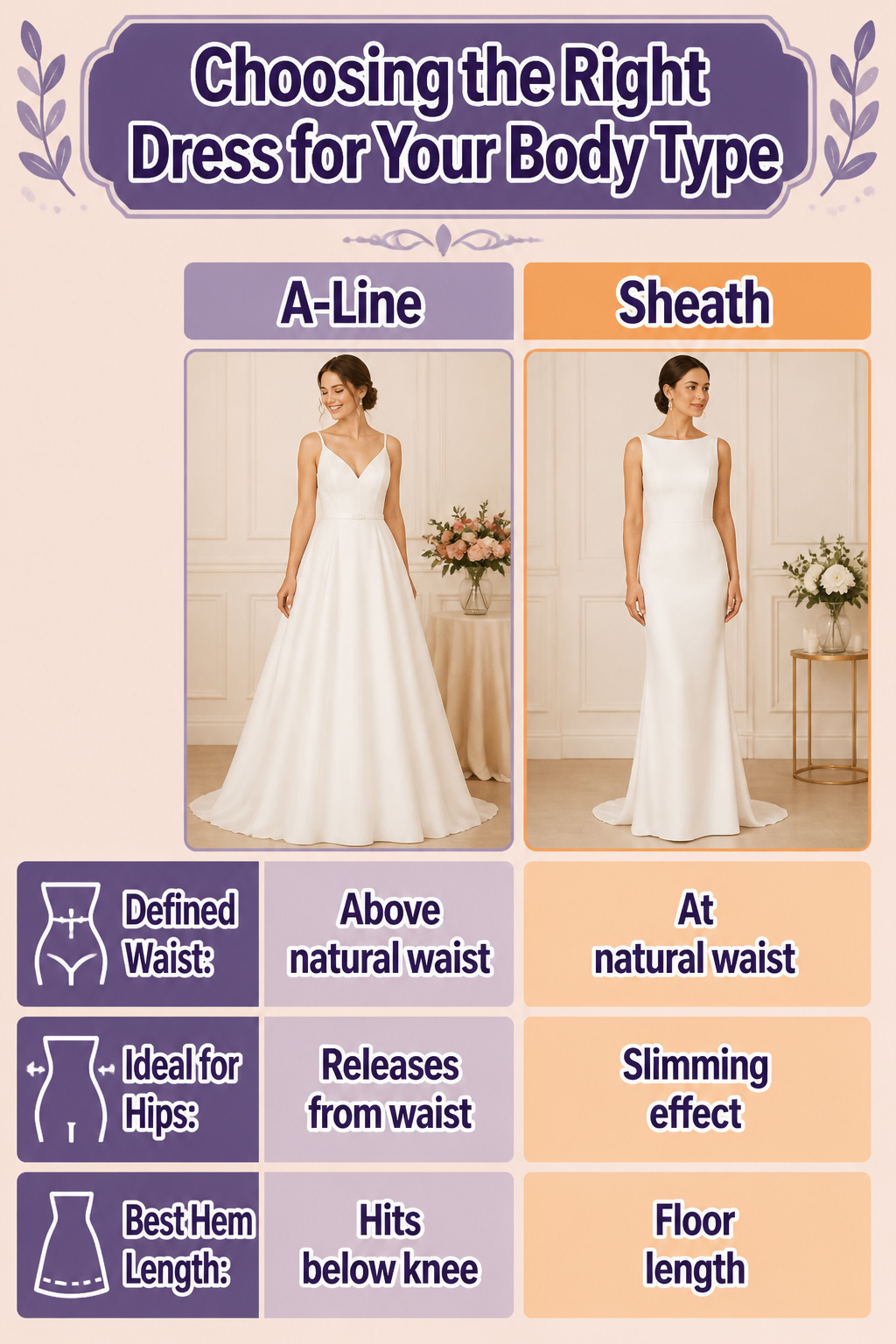
The right bridal reception dress starts with honest attention to where you naturally carry weight and where you want the eye to travel. An A-line skirt that releases from the waist works when you want breathing room through the hips without adding volume up top. A sheath keeps the line narrow from shoulder to hem, which reads as height but asks more of your posture and your underpinnings. Mermaid shapes pull in at the knee and flare below; they reward a defined waist and can feel restrictive if you plan to sit, dance, or eat much during the party.
A defined waistband set slightly above your natural waist is the most reliable move for creating proportion, especially in a reception dress where you will move more and photograph less formally than at the ceremony. If you are broader through the shoulders, a skirt with some sweep balances the frame. If you carry weight midsection, ruching across the torso does more good than a panel of stiff fabric that stands away and adds box. For petite frames, a hem that hits at or just below the knee keeps the dress from wearing you; taller women can carry a floor-length reception look without it reading as costume.
Fabric matters as much as cut. A heavier satin holds structure and smooths; chiffon and lighter layers need your own shape underneath to look intentional rather than accidental. When I am choosing between two sizes, I take the one that fits the widest point of my body and alter the rest. A reception dress you cannot sit down in is a dress you will leave in the hotel room by nine o’clock.
Lace, Satin and Chiffon
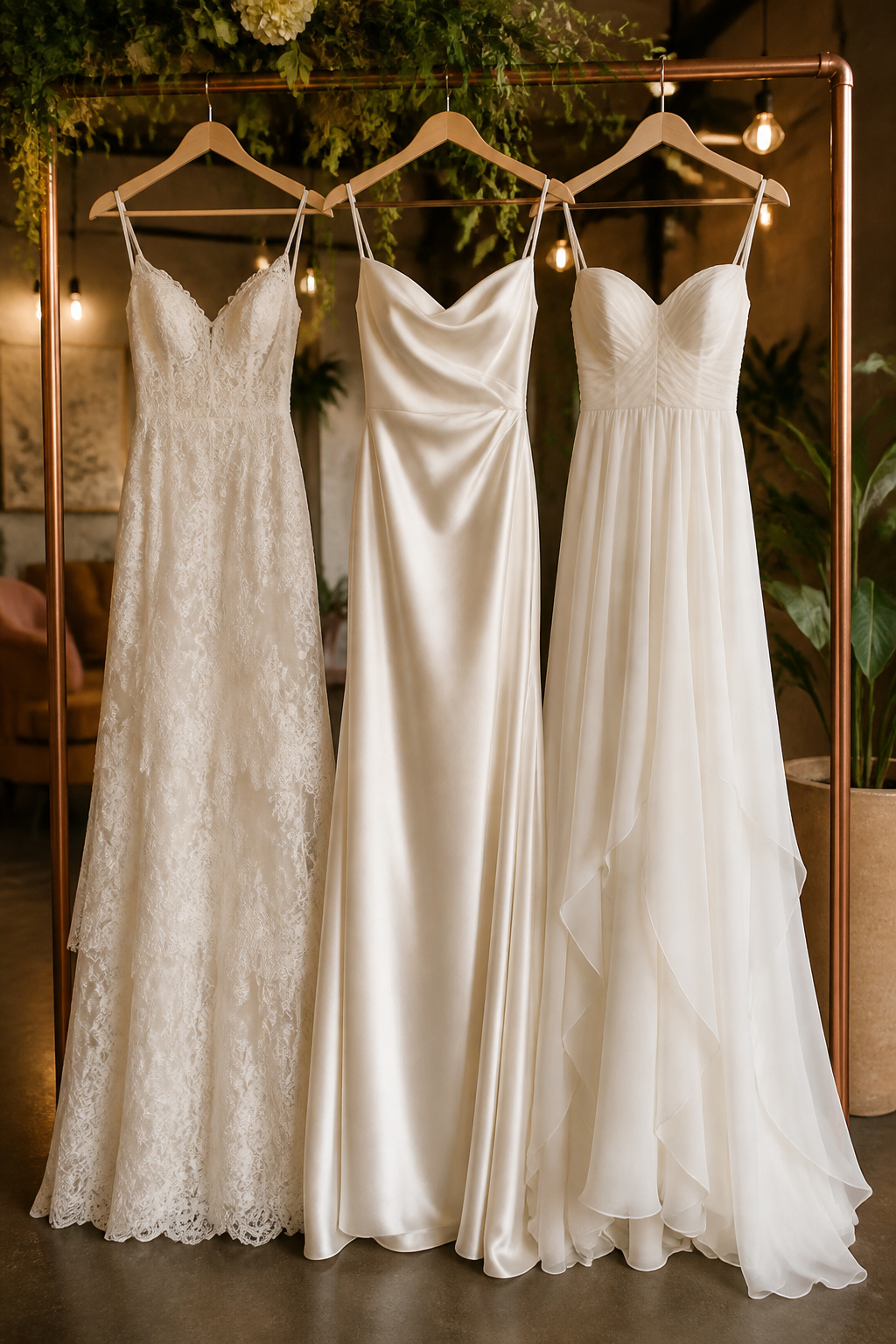
Lace, satin, and chiffon each carry a reception differently, and the choice matters more than most brides expect going in. Lace adds texture without weight, working best in sleeves or overlays where you want visual interest that photographs softly under dim ballroom light. The catch is the itch factor: not all lace is lined, and six hours of dancing against bare skin turns romantic into regrettable fast.
Satin reads formal and catches candlelight beautifully, though it shows every water spot and wrinkle from the car ride over. If the reception runs warm, the lack of breathability becomes obvious around hour three. Chiffon fixes that problem, floating airily and forgiving a rushed entrance, but the same lightness means it crushes if someone steps on the hem during the hora. I have watched a bride spend her entire cocktail hour steaming chiffon panels in a hotel bathroom that smelled of cleaning solution.
For comfort across a long evening, lining quality matters more than the top fabric name. Unlined satin sticks; unlined lace scratches; unlined chiffon goes sheer under flash photography. Ask about the underlayer before falling for the sample on the hanger.
Length and Fit Comparison
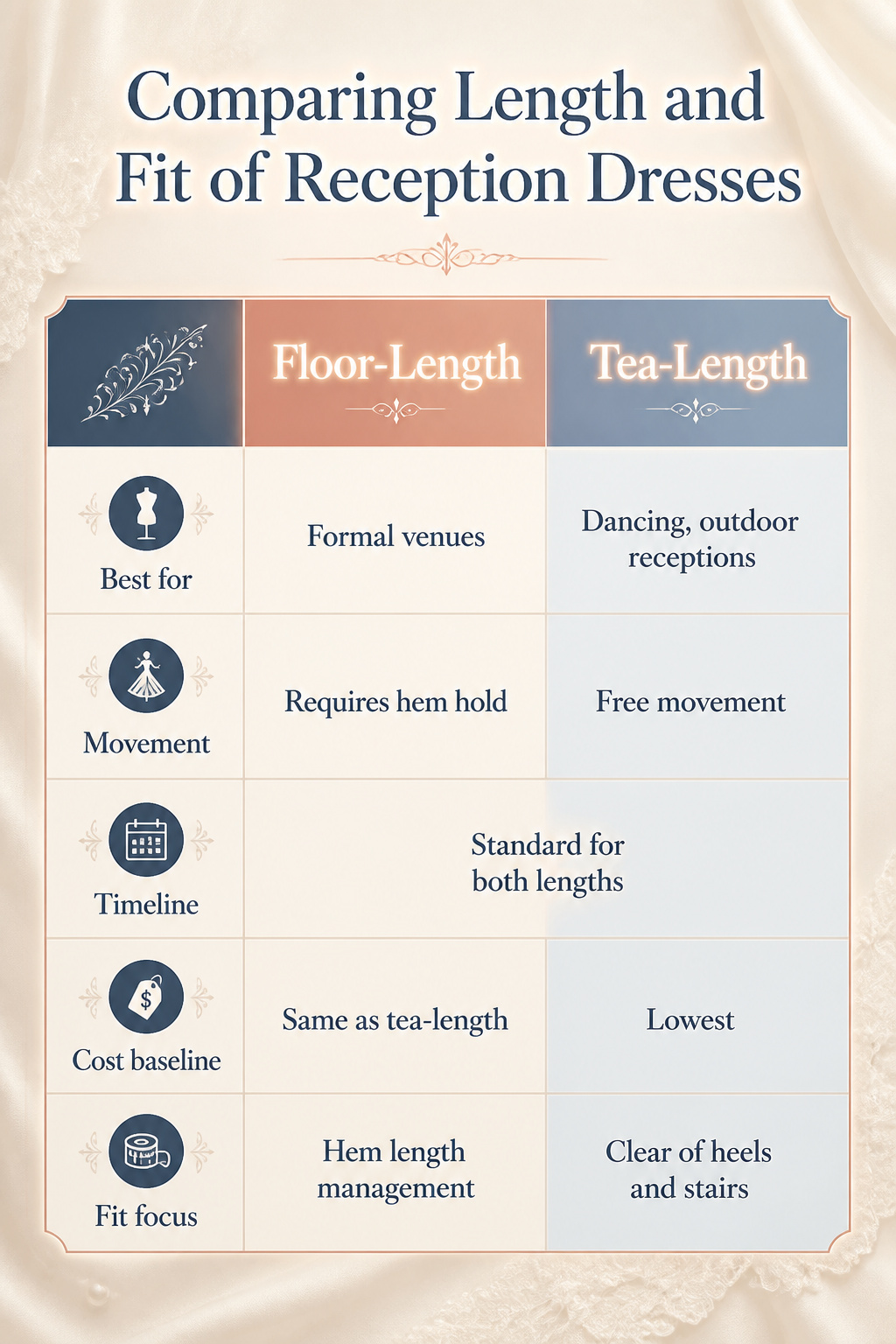
The gap between floor-length and tea-length bridal reception dresses is not just visual; it changes how you move through the entire evening. Floor-length hems sweep the floor and demand a hemline check if you are under 5’4" or plan to dance without holding fabric. Tea-length, landing mid-calf, stays clear of heels and stairs but can shorten the leg line depending on where the break hits your calf.
Fit works the same way. Standard sizing assumes a B-cup and a waist that sits at the natural point, which misses a lot of bodies. Plus-size bridal reception dresses built with actual curve grading, not just wider panels, sit differently at the underbust and hip; the difference shows up after an hour of sitting, not in the mirror. Custom fills the gap when your proportions sit outside the standard block, though the cost and the six-to-twelve-week wait are real limits.
| Feature | Floor-Length | Tea-Length | Standard Fit | Plus-Size | Custom |
|---|---|---|---|---|---|
| Best for | Formal venues, tall frames | Dancing, outdoor receptions, petite builds | B-cup, waist at natural point | Curved grading at bust and hip | Proportions outside standard blocks |
| Movement | Requires hem hold on stairs; risk of stepping on hem | Free movement; heel-friendly | Off-the-rack speed | Better hour+ comfort | Tailored drape |
| Timeline | Standard for both lengths | Immediate to 2 weeks | 1–3 weeks | 6–12 weeks | |
| Cost baseline | Same as tea-length in most lines | Lowest | 10–30% premium | 40–100% premium |
If you are between sizes or carry weight in one area, the plus-size cut saves the alteration cost that standard sizing would force anyway. Custom only earns its price when three or more measurements fall outside the size chart, not for one stubborn point.
What Season Changes
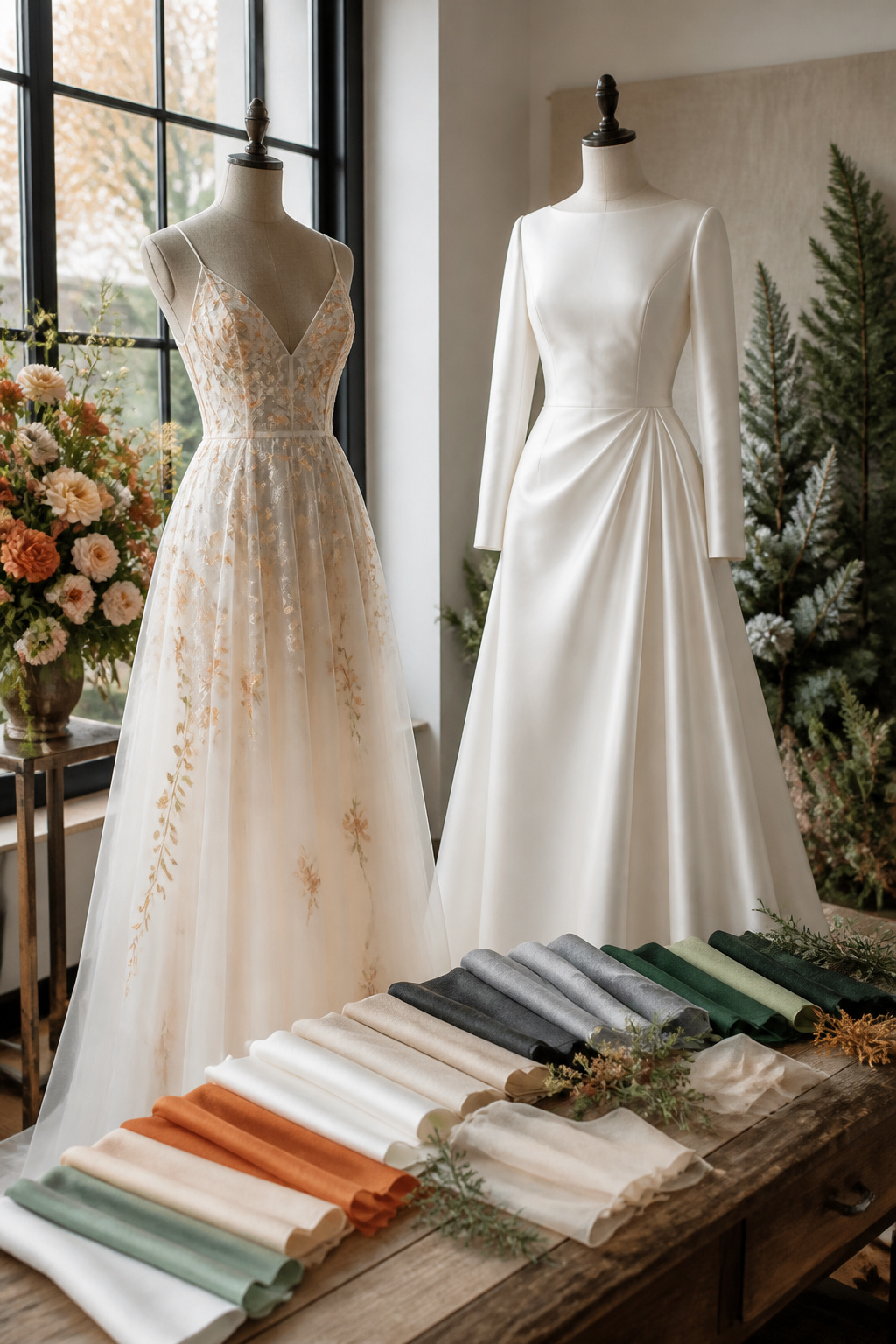
Fabric weight is the first thing that shifts when the season changes. A summer bridal reception dress in chiffon or organza moves easily in heat and does not cling, while the same silhouette in winter needs heavier satin or a lined crepe to hold its shape against a drafty venue. Color follows the same logic, though not as rigidly as the old rules suggest. Blush and champagne read warm under October candlelight; navy or emerald feel grounded in July when the room is already bright with sun. Coverage matters more than color, in my experience reading through the options that actually get reordered. Long sleeves on a reception dress make sense for a December party, but the real test is whether the venue runs air conditioning aggressively in August too. A detachable sleeve or a light wrap solves both problems without buying two dresses. The mistake I see most often is choosing a fabric so sheer it works for exactly one outdoor hour, or so heavy that dancing becomes a chore by the second song. The practical balance is a mid-weight fabric with structure you can layer up or strip down, and a color that photographs well in the specific light you will actually have, not the light on the invitation’s mood board.
Frequently Asked Questions
What styles are available for bridal reception dresses?
A-line, ball gown, sheath, mermaid, tea-length, and bohemian styles are the main silhouettes available. A-line remains the most recommended across style roundups because it flatters nearly every body shape without demanding extensive alterations. Ball gowns suit grand, formal receptions with space to move, while sheath and mermaid cuts read modern and dramatic for different body types and venue moods.
How do I choose the right dress for my body type?
Start with where you naturally carry weight and how much you plan to move during the party. An A-line skirt that releases from the natural waist works for the widest range of bodies, especially if you want room through the hips. A defined waistband set slightly above your natural waist creates the most reliable proportion for reception photos and movement. Take the size that fits your widest point and alter the rest; a dress you cannot sit in will end up in the hotel room by nine o’clock.
What materials are commonly used in bridal reception dresses?
Lace, satin, and chiffon are the three most common fabrics, and each carries the evening differently. Lace adds texture without weight but can itch against bare skin if unlined. Satin catches candlelight beautifully yet shows every wrinkle and traps heat after a few hours. Chiffon breathes and floats but crushes easily and may need steaming after contact. The quality of the lining beneath any of these matters more than the top fabric name for comfort across a long evening.
Are there plus-size options available for bridal reception dresses?
Yes, and the market has shifted noticeably in the last five years toward designs built above a size 16 from the first sketch rather than scaled up later. The difference shows most at the waist: a bodice graded up from a smaller block tends to flatten curves or gap at the back, while one drafted for a fuller midsection sits still while you move. Check whether the brand lists finished garment measurements for waist and hip, not just a size chart; the half-inch difference between two brands’ size 18 is often the difference between a dress that needs tailoring and one that does not.