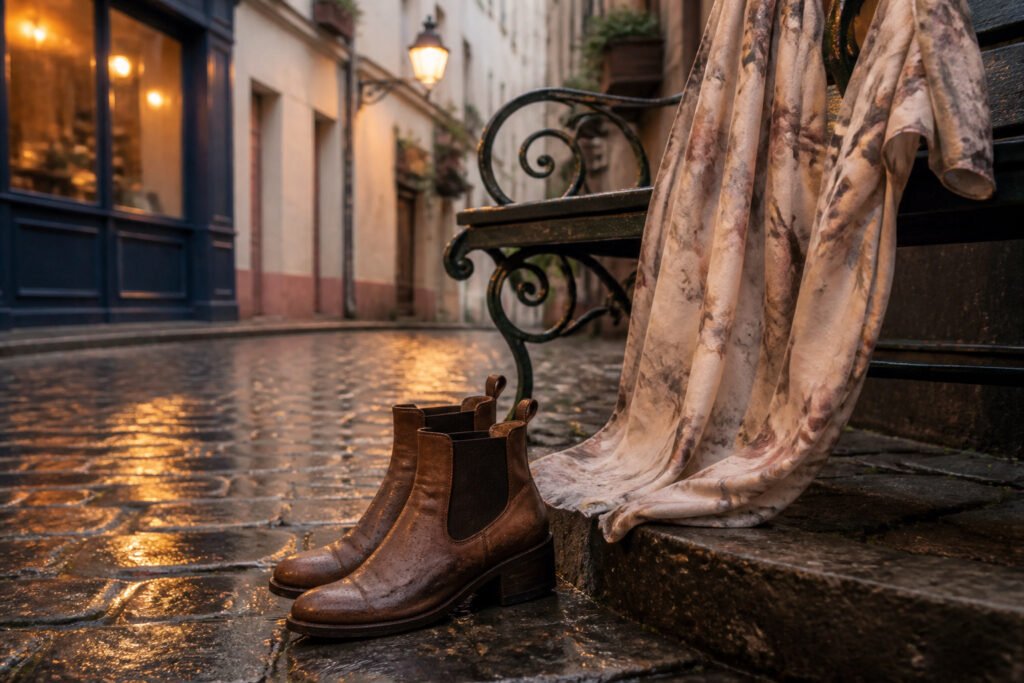
Pack 19 pieces, not 20, and leave that last slot empty for what you will find in Le Marais. The extra space pays for itself at Marché aux Puces de Saint-Ouen, where a silk blouse with the right drape never announces itself from the sidewalk. Blondo waterproof boots handle the October rain that turns mild mornings into soaked afternoons; a trench over a light sweater peels off by noon and you are still dressed.
1. Comfortable Walking Shoes

Parisian streets will punish the wrong footwear. Cobblestones run through the Marais, Montmartre’s hills demand steady footing, and a full day of walking from Père Lachaise to the Arc de Triomphe leaves no room for shoes that need breaking in. French women skip high heels for daily wear, saving them for Fashion Week or special occasions where a car door to restaurant door path exists. The practical choice lands on clean, minimal sneakers or low-profile runners, with white platform styles currently common in the city. Ballerina flats and three-inch wedges fill the gap for evenings when comfort still matters but the look needs more intention. A strip of Moleskin at the heel prevents the blisters that new shoes always seem to promise, and that wiggle room for swollen feet is worth planning for before you pack.
2. A Classic Trench Coat

A trench coat handles the gap between seasons better than anything else in your bag. Paris spring mornings can start at forty-something degrees and hit sixty by noon, sometimes with rain that shows up without warning. The same coat works again in fall when the pattern reverses. I pack mine because it layers over a sweater without looking bulky, and the water-resistant shell beats carrying a separate raincoat that I’d resent by day three. Leather jackets do similar work, but they soak through where a treated cotton gabardine sheds light rain. Sources on Paris packing consistently pair the two: trench for drizzle and wind, leather for dry cool days. My rule is the trench wins if the forecast shows any chance of precipitation, which in spring and fall means most days. Water-resistant shoes matter just as much; suede will stain on the first wet cobblestone. A travel umbrella fits in the coat pocket, though I usually buy a cheap one in Paris if the sky opens. The tailored belt and clean lines also pass at a café table or a museum entrance without the athletic-wear look that marks visitors immediately.
3. Stylish Flats or Mules

Paris chews through heels. The cobblestones, the metro stairs, the museum floors: they turn a three-inch pump into a liability by noon. What actually works is a backless mule with enough structure to read as dressed, or a refined flat that does not apologize for being comfortable.
The Sarah Flint Natalie flat, for instance, pairs with evening denim without looking like you gave up. Mules hit the same balance. Manolo Blahnik’s Maysale backless style clops along all day and still passes at a wrap-dress dinner, while the Marie Antoinette collection and Jimmy Choo’s lace-up versions are what the fashion-week crowd is actually wearing this season.
Three-inch wedges are as comfortable as running shoes, and they add height the cobblestones will not punish. Ballerina flats work too, though the current Paris look leans toward a slightly heavier sole. White platform runners are everywhere right now if your itinerary is more Left Bank wandering than Right Bank dining, but for a single pair that covers both, a polished mule or structured flat wins.
4. A Little Black Dress

A black midi dress earns its place in any Paris suitcase, no matter the season. The weather in spring can swing from rainy and cold to warm and sunny, and a little black dress layers under a trench coat or leather jacket just as easily as it stands alone on a mild evening. For dinner, the dress code at places like Le Jules Verne or a Seine River cruise leans polished; a sleeveless LBD with clean lines reads intentional without trying too hard. Day to night, the same dress works with walking sneakers for morning coffee at Brasserie Dubillot, then shifts to tights and a blazer for Champagne at Cheval Blanc. Some travelers prefer a mini length with patterned hosiery, though a midi tends to cover more ground across different restaurants and seasons. I always look for mine at La Ligne, but the key is cut over label: a shape that fits well enough to skip the alterations.
5. Lightweight Sweater or Cardigan

A lightweight sweater or cardigan belongs in your bag no matter when you fly to Paris. Even July evenings along the Seine can turn cool enough that you’ll reach for it, and the locals do the same. I usually fold a cherry red cardigan near the top so I can grab it if dinner runs late, though navy, chocolate, or dark gray will carry you through more outfits if you prefer one piece to do more work.
The shape matters more than the color. A boxy knit layers cleanly over a slip dress or tucks into high-waisted jeans without bulk, and a ribbed cuff at the wrist reads finished when you push the sleeves up. Sézane makes one that packs small and holds its shape after being stuffed in a tote all day.
Pashminas and blazers work too, but a cardigan has the edge for travel. It softens a daytime look without trying hard, and you can knot it over your shoulders when the afternoon warms. A leather jacket or trench handles rain and real cold; the sweater handles everything else.
6. Tailored Blazer

A tailored blazer is the fastest way to pull an outfit together when the dress code sits somewhere between café chair and white tablecloth. The right shape, whether a nipped waist or a double-breasted cut with padded shoulders, does the work of making jeans and a tee feel intentional rather than accidental. I look for velvet accents or oversized buttons when I want the piece to read as considered, not corporate.
"Parisienne style is easy if you follow this simple rule: banish ‘occasion dressing.’ The quintessential French outfit can take you from brunch to work, school drop-off to birthday drinks, all in one effortless look."
That single piece bridges the gap between a silk floral dress at Septime and the same look at a corner bistro the next morning. Balance the formality with flat sandals and the blazer keeps you from looking like you tried too hard or not enough, which in Paris is the line you want to walk.
7. Stylish Tote or Crossbody Bag

A cross-body bag leaves your hands free for metro turnstiles, maps, and the pastries you will buy while walking. That hands-free convenience matters more in Paris than in most cities, because the best way to learn the place is still on foot, getting lost in side streets and passageways where a backpack makes you an easy mark. I stay away from travel backpacks; it is too simple for someone to get in and out while it sits on your back and your attention is on a storefront or a map. A top-zip tote is the safer daytime choice, worn on one shoulder with the zipper toward your body. The Cuyana tote I have carried holds a camera, a small travel wallet, a reusable water bottle, and a small umbrella without looking like luggage. For evenings, a smaller crossbody works if you travel light. The Rive Droite style, worn across the chest, is the modern Parisian take on the old belt bag and is common among women in the city right now. Two bags total: one for day, one small for night. That is the limit.
8. High-Waisted Jeans

Jeans absolutely belong in a Paris suitcase, though the cut makes the difference between looking dressed and looking like you stopped sightseeing to change. High-waisted jeans read as intentional there because the rise creates a defined waistline that pairs cleanly with tucked or cropped tops rather than hanging loosely underneath. French designer Jeanne Damas calls them essential in her own uniform; she tucks sweaters into them deliberately, sometimes sizing up for a softer drape, and shifts the same pair into evening with a nice top and mules. Black jeans work particularly well in fall and winter, worn with a tweed jacket and ballet flats as a nod to the classic Hepburn silhouette. For a polished casual dinner, a dressier black top with kitten heels or refined flats keeps the look elevated without trying too hard. The waist height is what elevates the entire outfit: it structures the silhouette so the jeans function as a deliberate choice, not a default.
9. Scarf as Accessory

A scarf in Paris is an accessory, not a rescue mission. Locals wear them as deliberate additions to an already complete outfit, not as a cover-up for whatever else fell through. That distinction matters when you’re standing in front of a hotel mirror wondering whether the silk square actually works with yesterday’s sweater.
Practical warmth is only half the job. A lightweight wool or cotton scarf handles spring breezes and autumn metro drafts without the bulk of a full layer, and the same piece signals that you bothered. The Parisians I read about treat this as everyday grammar, not weekend effort.
If your current collection feels too loud or too limp, leave the slot open. One source suggests buying once you land, and the logic holds: a scarf picked up at a place like Galeries Lafayette carries the local color temperature in a way the airport kiosk usually misses. Packing one reliable neutral is the safer bet for anyone who’d rather not spend the first morning shopping instead of walking.
10. Midi Dress

A midi dress in solid black handles more of a Paris trip than almost anything else in the suitcase. I have worn the same one to a late dinner along the Seine and to a morning market in the 7th, and the difference was just what went over it. The length hits that middle ground where you are not underdressed for a brasserie and not overdressed for a metro ride.
Seasonality is where this piece earns its space. In spring, when Paris can swing from rain and cold to warm sun inside a single afternoon, the midi dress becomes a layer you build around. A light sweater over the shoulders handles the morning chill, and you can shed it by noon. The sources I trust for this kind of dress include La Ligne, J.Crew, Reformation, and Staud. For evening, I skip the trench, which reads daytime to me in that city, and top the dress with a blazer instead. Sezane, Veronica Beard, and Aritzia are where I look for that layer. A belt from Madewell or Aureum cinched at the waist turns the same dress into a second outfit without adding another garment to the bag.
The real value is that a black midi works year-round. One source notes that a little black dress packed any season is an excellent option because you never know when you might need it. I have found that true in Paris more than anywhere else.
11. Linen Pants

Linen pants solve the summer problem that jeans and leggings never quite manage in Paris. The fabric breathes in real heat, and the cut reads deliberate rather than like the yoga-pants-and-sneakers outfit that immediately tags someone as a visitor. I pack mine for exactly that reason: they move between a morning at Marché aux Puces de Saint-Ouen and an afternoon in Le Marais without looking like I changed for the occasion.
The sources back this up practically. Lightweight khaki or linen trousers are what Paris Insiders Guide recommends when the city sizzles, and Harper’s Bazaar specifically pairs linen pants with a simple tank and woven sandals for vintage shopping. That textural finish matters. Linen wrinkles, but the wrinkling looks intentional on a wide-leg or straight cut in a neutral tone, whereas creased athletic fabric just looks slept-in.
One judgment call: leave the shorts at home unless the forecast hits 95°F. Even then, linen pants in a pale color handle the heat without the tourist-athleisure look that local style quietly avoids.
12. Slip Dress

A slip dress in silk or satin handles the Paris evening dress code without ever looking like you tried too hard. French designer Jeanne Damas counts them among her essentials, particularly for summer, and that tracks with what I notice once the sun drops: the same cafés that feel casual at noon turn into places where a cotton sundress starts to feel underdressed.
The real move is layering. A slip dress packs flat, barely registers in your suitcase, and still reads as intentional under a leather jacket or a simple sweater. I find the sweet spot is bringing one that skims rather than clings; you want to look dressed, not undressed. For day-to-night, the transition is the jacket coming off, not a full change. A sleek boot after dark, sneakers earlier, and you have two outfits from one piece that takes up less room than a single pair of jeans.
Jenni Kayne and J.Crew are reliable sources for cut and fabric that hold up to this kind of rotation. If you are testing one before the trip, wear it through a full day: sit in it, walk in it, see where it catches or pulls. The ones that survive that test are the ones worth the luggage space.
13. Statement Jewelry

A single pair of vintage-leaning statement earrings does more to lift a plain dress in Paris than a suitcase of one-off bold pieces ever could. The restraint is the point: French style runs on minimal jewelry that reads as polished rather than piled on, and a good earring hits that note without asking for a second outfit change between brunch and dinner. One quality pair, worn repeatedly, beats packing five necklaces you hesitate to reach for. The real math is in the mix. A strapless column dress for evening wants that single earring with some age to it, while the same blazer-and-denim uniform from morning walks straight into a café without looking like you tried. Packing light here means choosing the one piece that feels intentional against everything else in the bag, not the piece that demands its own look.
14. Waterproof Shoes

Paris weather has a habit of turning on you mid-stroll, and waterproof boots are what keep the day from ending early. Blondo makes the pair I keep coming back to: comfortable enough for cobblestones, sealed against sudden rain, and stocked in more styles come fall. The brand sold out fast in 2022, which tells you how many travelers learned the hard way.
Spring trips call for the same caution. Water-resistant shoes, not suede, are the safer bet when skies shift from bright to gray before lunch. A travel umbrella helps, but shoes take the real beating.
15. Comfortable Trousers

Jeans have their place, but Paris rewards a step up. Wide-leg trousers in silk or satin read as polished while feeling like pajamas, which matters when you are walking cobblestones from a morning croissant to a late dinner. The Toteme patterned silk pants carry that joke literally: fluid, patterned, and still right for a wine bar. Varley’s satin pant and the LaLigne Colby run more minimal, and the Jenni Kayne Demi Pant widens the leg further if you want movement.
A single pair can shift from day to evening. During the day, drapey trousers with sneakers keep the look grounded; swap in ballet flats or a slim heel after six and add a belt or small earrings to pull the monochromatic line together. If the weather turns warm, a long-sleeve shirt in a dressier fabric replaces the sweater without losing the effect.
16. Dressy Top for Evenings

One elevated top earns its spot on a Paris packing list by handling three different evenings out. At relaxed bistros where jeans are widely worn even at night, a polished blouse or a blazer upgrade keeps the look intentional rather than sloppy. Nicer restaurants call for more refinement: a beautiful top with tailored trousers or a midi dress reads as elevated without crossing into overly formal territory. The real dress code variation shows up at coveted tables like Septime or Chez Georges, where a silk piece with delicate detail, balanced by flat sandals, strikes the right note of insouciance. "Elevated casual" is the best way to describe Paris after dark: effortless, never sloppy, and always more dressy than casual. A single top in a luxe fabric, maybe with lace trim or a sculptural cut, covers all three tiers if you change what sits below it.
17. Wide-Leg Trousers

Wide-leg trousers carry a different silhouette than the comfortable, drapey pairs that dominate travel packing lists. The volume sits deliberate and structured, not relaxed and easy, and that distinction changes how you style them. Barrel-leg cuts taper back toward the ankle, grazing it precisely to leave room for a ballet flat or mule without pooling fabric. The proportion play works across body types, though sizing up slightly buys the slouch that reads as intentional rather than borrowed from loungewear.
For Paris, the styling shift matters more than the fabric weight. A monochromatic sweater-and-trouser combination reads polished here where the same pieces in a drawstring or elastic-waist version would signal airport comfort. The swap from daytime sneakers to evening flats or a slim heel happens cleanly because the trouser leg creates a continuous line; nothing breaks at the ankle. A simple belt or small earrings finish it, but the silhouette itself does most of the work. Size up for the cut to read as chic rather than cautious, and keep the length exact. Too long and the shoe disappears; too short and the proportion collapses into capri territory.
18. Casual Dress

A casual dress for daytime Paris exploring needs to be the thing you grab when the museum opens in an hour and you still want to look like you belong on the street, not at the beach. Cotton jersey or a light woven that holds its shape through a full day of walking separates this category from the slip dresses and midi dresses you’ll pack for other moments. The slip dress is silk or satin, cut to catch evening light; the midi often reads as the outfit itself. The casual dress works harder, layers under the sweater or blazer you’ll need when summer temperatures drop at night, and covers enough ground to walk into a cathedral without the second thought you’d give a spaghetti strap.
Jeanne Damas points to the wrap dress as her daily uniform, something that functions on any occasion. That multifunctional quality is what you’re after in this slot: one piece that handles the café, the gallery, and the afternoon walk without a change. I look for a length that sits at or just above the knee, sleeves that solve the church and museum question before you ask it, and a fabric that doesn’t demand careful handling while you travel.
19. Vintage or Secondhand Finds

Vintage racks in Paris run on a different clock than the ones back home, and the pieces you actually want, a silk blouse with the right drape or a leather belt worn soft, rarely announce themselves from the sidewalk. Leave a quarter of your suitcase empty before you fly. The Marie Kondo method in reverse: you are packing to come back with more, not less. One pair of trousers, one skirt, one blazer, and a dress with coordinating tops is enough for the week; duplicates stay home and stay unworn. The Marché aux Puces de Saint-Ouen and the secondhand shops of Le Marais reward the same eye for quality-over-quantity that probably got you reading this in the first place. A periwinkle tank, linen pants, and woven sandals handle the stalls without looking like you dressed for a costume drama. What you find there folds into a wardrobe you already own, not a new personality you have to build around.
Seasonal Packing

The same 19 pieces shift weight depending on when you land. A floral dress that reads autumn with boots in October works spring with ballet flats the moment the light changes. That white dress I keep mentioning? Tailored jacket and heels after dark, sneakers by afternoon; the season only decides which layer stays on.
Spring and fall demand the most care. Trench coat over leather jacket over light sweater; peel one off by noon and you’re still dressed. Blondo waterproof boots carried me through a wet October week that started mild and ended in cold rain. Summer strips back to the slip dress, the linen pants, the sun hat you almost left home. Heat waves happen; jeans stay in the drawer then.
Unpredictable weather is the only constant. A little black dress lives in the suitcase year-round because Paris turns formal fast. Cashmere, that same scarf, the simple dress: these cross seasons unchanged. The capsule doesn’t grow, it reorders.
Footwear Rules

Cobblestones will ruin a day faster than rain ever could. The gaps between those worn stones catch narrow heels and send them sideways, while flip-flops offer no protection at all and slap loudly enough to draw stares in a quiet gallery. Leave both at home.
Comfortable wedges around three inches work as well as runners for long museum days and still look intentional at dinner. For flat options, broken-in ballerina flats handle the Metro stairs without the bulk of sneakers. If your feet swell when you walk, size up slightly and add Moleskin to the heel cup before you leave; that small cushion prevents the blisters that turn a week in Paris into a limping regret.
Waterproof boots matter in fall and winter, when leaves slick the stones and sudden rain soaks through ordinary leather. Blondo makes comfortable waterproof styles that handle both, and they restock seasonal shapes each autumn. White platform runners are having a moment in Paris right now, though they do nothing for wet weather.
Break in every pair before the trip. New shoes on cobblestones are a mistake you only make once.
Dressing for Cafés to Fine Dining
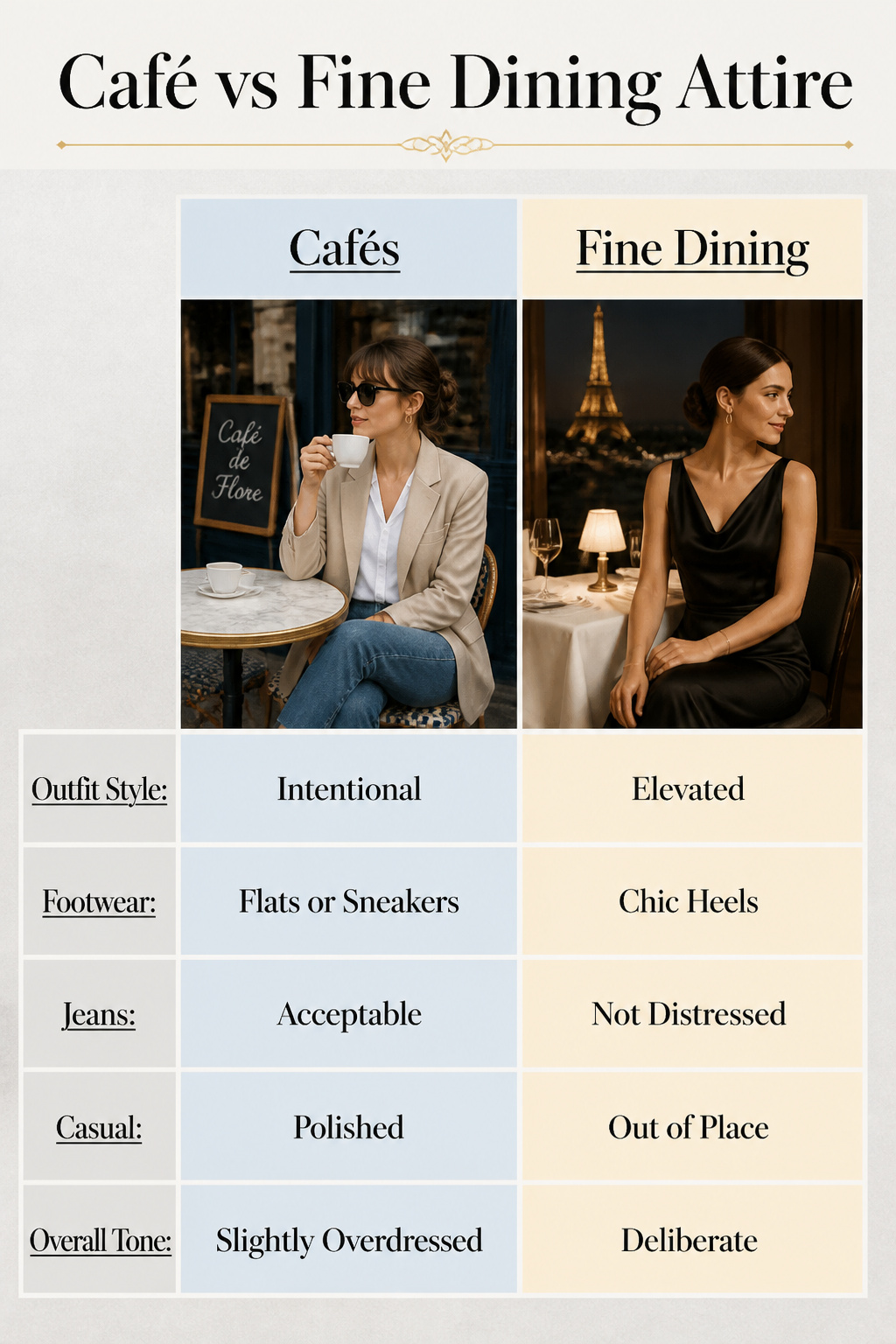
Parisian cafés expect a level of polish that sits just above what most Americans grab for coffee. A great pair of jeans with a blazer, a simple dress with flats, or tailored trousers with a knit all read as intentional without trying too hard. The same outfit often carries through to brasseries and popular dinner spots, maybe with a swap to a midi dress or a chic top if the evening calls for it.
Fine dining demands more thought, not more formality. A Michelin-starred table, a Seine dinner cruise, or a seat at Le Jules Verne calls for elevated pieces: a black dress, sleek heels, or a beautifully styled look that feels deliberate. Gowns are overkill; intention is the point.
Clean, minimal sneakers styled well can work. Jeans are fine if they are not distressed. Heels are not required; a chic flat or loafer holds its own. Athleisure, flip flops, and overly casual pieces will feel out of place.
The real skill is the day-to-night transition. A wrap dress, a men’s style jacket, or high-waisted jeans with a nice top and mules shift the tone without a full change. Polished beats casual every time in this city; you will not regret being slightly overdressed.
What to Skip

Yoga pants, baseball caps, and logo T-shirts read as unconsidered the moment you step onto a Paris metro platform. The city operates on a baseline of elevated casual, where tailoring and intention matter more than effort. Athleisure in particular signals that no thought went into the transition between activities, and Parisian dress codes tighten noticeably after dark.
Flip-flops and high heels share a single problem: neither survives cobblestones, museum marble, or the stairs between metro lines. Comfortable wedges or polished walking shoes handle the same terrain without the tourist broadcast. What convinced me, reading through a dozen of these guides, was how consistently the advice lands on polish over practicality alone. A pair of dark, well-fitted trousers with a simple sweater meets the evening standard where sportswear, however expensive, does not.
Capsule Wardrobe Math

Nineteen pieces sounds like a lot until you start laying them out on the hotel bed and realize the black trousers talk to every top in the bag. The trench, the blazer, the slip dress, the little black dress, two pairs of shoes that actually work, and a handful of knits and tees: that is the full list, and the math works because nothing sits in isolation.
A capsule wardrobe only functions when each item earns its weight in combinations. The tailored blazer pulls the slip dress into a dinner reservation at Septime. The same blazer over a white tee with high-waisted jeans handles a morning at the Marché d’Aligre. The trench goes over both. The lightweight sweater ties around shoulders for a café afternoon and gets worn properly when the sun drops behind the buildings on Rue de Rivoli.
The real test is three outfits per piece minimum. The linen pants see a morning walk, an afternoon gallery, and an evening aperitif with a change of top and shoes. The midi dress works alone with flats, under the trench with sneakers, or dressed up with the evening top layered underneath and the statement earrings you packed. The scarf is not decoration; it is the difference between the Tuesday outfit and the Thursday one when you are photographing both.
What breaks the math is the single-use item. The dressy top that only pairs with one bottom, the shoe that only works with one dress. Paris packing leaves those at home. Every piece has to cross to another occasion, another temperature, another level of formality, or it stays in the drawer where you left it.
Current Paris Shoe Trends

Parisian women on the street right now are wearing sleek, sensible shoes in large numbers, with woven handbags and canvas hats finishing the look for summer. The flat silhouette dominates daytime, which makes sense given how much ground you cover on foot; the metro saves time, but walking reveals the city, and Parisian dressers clearly build their footwear around that reality. At night the tone shifts only slightly. Clean, minimal sneakers can pass for relaxed dinners if they are genuinely well kept, though a low block heel or polished loafer reads more intentional for anything above casual. The real distinction is condition, not height. Athletic sneakers worn down at the heel, or anything that looks like it came straight from a run, will feel out of place even where the overall outfit is simple. For cobblestone areas like Montmartre, a block heel or sturdy flat wins over a stiletto every time, and the women I watch on those streets seem to have already made that calculation.
Frequently Asked Questions
What should I wear in Paris?
Paris calls for a mix of comfortable and polished pieces: clean minimal sneakers or stylish flats for walking, a classic trench coat for unpredictable weather, high-waisted jeans styled with elevated tops, a little black dress that layers easily, and a tailored blazer to pull outfits together. French style favors timeless pieces that work from morning coffee to evening drinks without looking like you tried too hard.
Can you wear jeans in Paris?
Yes, but the cut and styling matter. High-waisted jeans read as intentional there because the rise creates a defined waistline that pairs cleanly with tucked or cropped tops. French designer Jeanne Damas calls them essential; she tucks sweaters into them deliberately and shifts the same pair into evening with a nice top and mules. Skip anything overly distressed or too casual.
What shoes should I wear in Paris?
Comfortable walking shoes are non-negotiable on cobblestones and metro stairs. Clean, minimal sneakers or low-profile runners work for daily wear, while ballerina flats and three-inch wedges fill the gap for evenings. French women save high heels for special occasions where a car door to restaurant door path exists. Break in every pair before you fly, and pack Moleskin for blister prevention.
Is there a dress code for restaurants in Paris?
Yes, and it varies by venue. Casual bistros want polished basics like jeans with a blazer or a simple dress with flats. Brasseries and popular dinner spots call for something more put-together: a midi dress, chic top with trousers, or a blazer layered over your daytime look. Fine dining and special experiences like Le Jules Verne or a Seine dinner cruise demand thoughtful, elevated pieces like a black dress or beautifully styled outfit that feels intentional. Sneakers are acceptable only if clean, minimal, and styled well.
What to pack for Paris in the summer?
Light, breathable layers are essential. Pack linen pants that move between markets and galleries without looking like you dressed for the beach, a slip dress in silk or satin for evenings, and a lightweight sweater or cardigan for cool nights along the Seine. A casual cotton dress with sleeves solves the church and museum question, and sun protection rounds it out. Skip shorts unless the forecast hits 95°F; even then, pale linen pants handle the heat without the tourist-athleisure look.