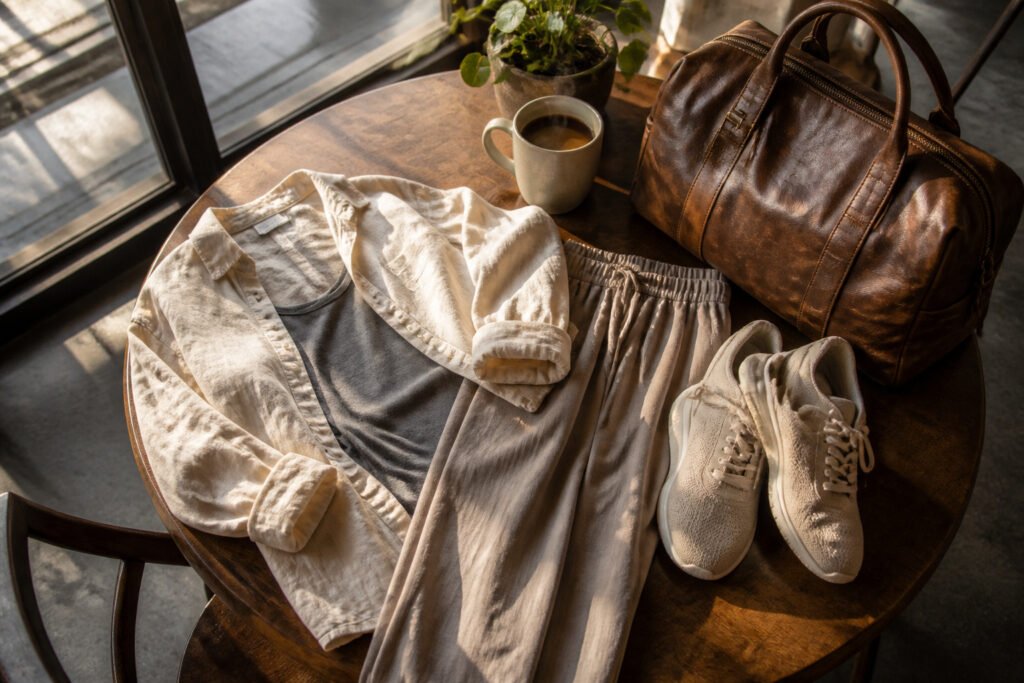
A travel outfit for a long flight is a system of layers that keeps you comfortable in three different temperatures without opening your bag. The catch is that most people pack for the plane they hope they get, not the one they actually board, where the cabin can jump from sweltering to freezing in the same hour. The 5–20 mmHg compression socks that prevent ankle swelling on a ten-hour haul only work if you put them on before boarding, not after.
1. Comfortable Sneakers

Supportive shoes are the single piece that can make or break a long travel day, and the right sneaker needs to handle three things: hours of walking, quick removal at security, and enough style that you do not look like you are heading to a gym. The New Balance 327 hits that balance with a cushioned sole that holds up through terminal sprints and a slightly retro shape that pairs with athleisure or even a casual sundress without screaming tourist. The Adidas Samba OG works the same way if you want a cleaner white sneaker profile, and both lace up tight enough for support but loosen quickly when you need to slip them off in the TSA line. If you are standing in a security queue and fumbling with knots or stiff backs, that shoe has already failed the travel test.
2. Travel Pants

The difference between pants that merely fit and pants that actually travel is how they look after five hours in a coach seat. Good travel pants resist wrinkles, stretch with you, and still read as put-together when you step off the plane.
Cozy Earth’s cropped pants have become my reliable choice for this. The cropped cut keeps the hem clear of airport restroom floors, and the fabric holds enough structure that I have worn them straight to dinner after landing. For a softer option, Vuori’s Performance Jogger feels like loungewear but pairs cleanly with a bomber jacket, something I would not have believed possible from sweatpants until I tried it. When neither specific pair is clean or available, any black pant that refuses to crease in the seat serves the same purpose.
3. Lightweight Sweater

Temperature on a plane is not a single place; it is two or three in the same six hours. The terminal runs warm, the jet bridge hotter still, and then the cabin drops to whatever the crew set last Tuesday. A sweater that lives in your bag has to handle that swing without becoming luggage of its own.
The Reformation Cashmere Boyfriend sweater is the one I keep reaching for. Cashmere wins here for two reasons that sound the same until you test them: the fiber is soft enough to sleep in, and it packs down small enough that the sweater does not fight the rest of your carry-on for room. The Boyfriend cut is oversized without being sloppy, so it layers over a tee in the terminal and still reads as intentional when you pull it on at altitude.
Stripes help, too. Horizontal ones add just enough visual texture that the sweater does not look like an afterthought, but the palette stays neutral enough to work with whatever you packed. In summer, it drapes over shoulders with a dress and functions as a third piece that actually earns its space.
4. Perfect Tee
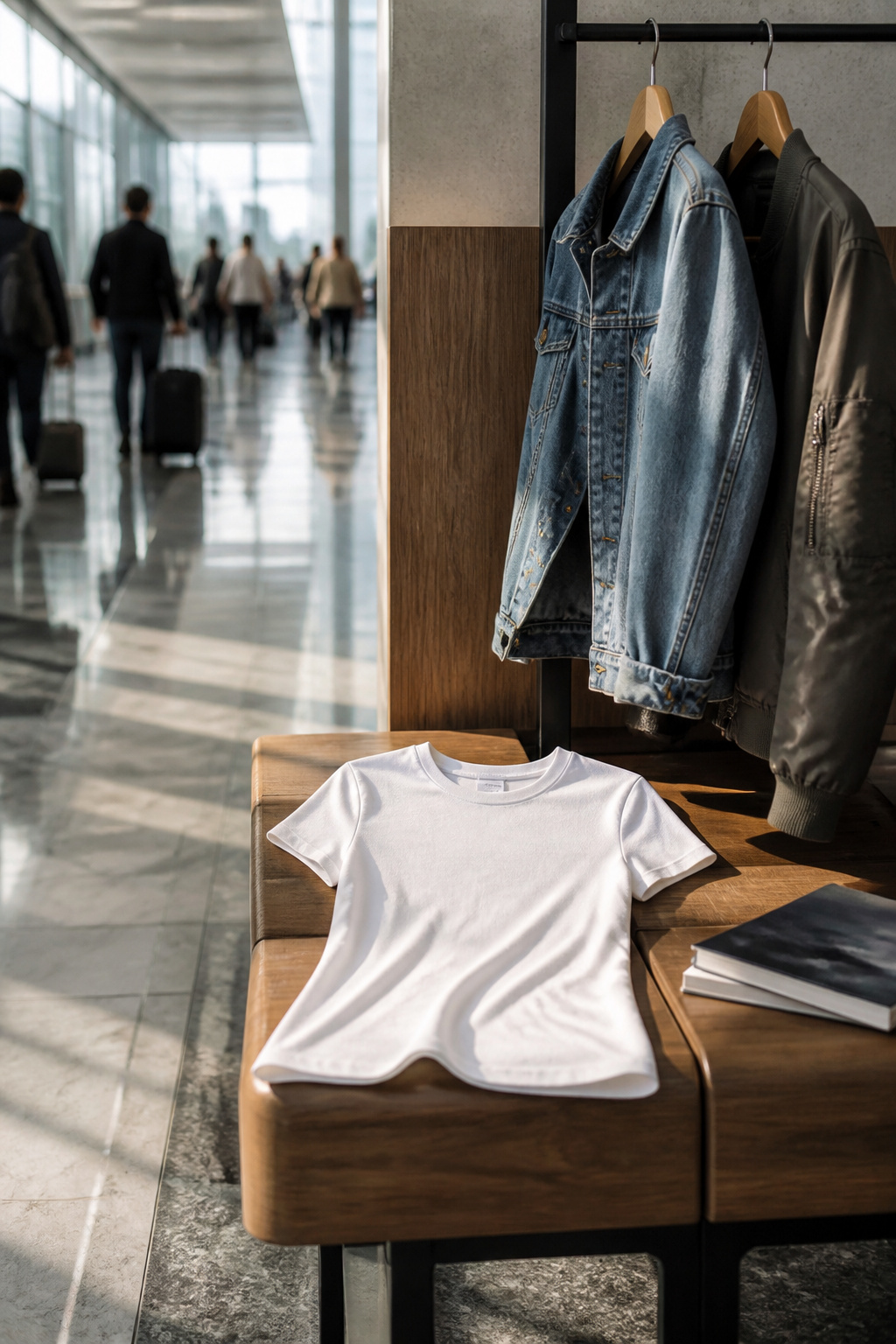
A white tee is the quiet workhorse of any travel outfit, and the Abercrombie Essential baby T-shirt is the one that actually earns its place in a carry-on. The cut sits close enough to read polished under a blazer or bomber, yet it still works on its own with joggers or jeans once you land. What makes a tee worth packing comes down to three things: fabric weight heavy enough to keep its shape through hours of sitting, a neckline that does not gape or curl after one wash, and a finish that looks intentional rather than like an afterthought. The Abercrombie hits that balance, and it doubles as a base layer beneath open cardigans or button-downs when the cabin temperature drops. For a softer, performance-oriented alternative, the Vuori Energy Tee brings moisture-wicking and UV protection into the mix. Everlane works if you want a boxier, more relaxed silhouette instead.
5. Bomber Jacket

A bomber jacket gives a travel outfit the structure most flight layers lack. The ribbed hem and cuffs hold a shape that reads intentional at the gate and still stretches comfortably for a ten-hour haul. Women’s versions have increasingly borrowed from men’s cuts, and the difference shows in the shoulder and sleeve. The Lululemon Men’s Collegiate bomber is roomy without turning boxy, light enough to pack small in a carry-on yet warm enough when the cabin AC kicks in. Water-resistant and windproof fabric means it works if you’re stuck on a jet bridge in January. Across body types, the cropped length keeps proportions clean: it hits at the hip rather than mid-thigh, so the silhouette doesn’t swallow a shorter frame or strain across the shoulders on a broader one. If the men’s sizing runs long in the sleeve, a quick roll at the cuff fixes it without looking borrowed. For those who want a women’s cut built to the same spec, the Athleta Jetset Bomber carries the same water-repellent shell in a trimmer block, though the swish and give of the men’s cut is what makes the hours in 24B tolerable.
6. Travel Wrap
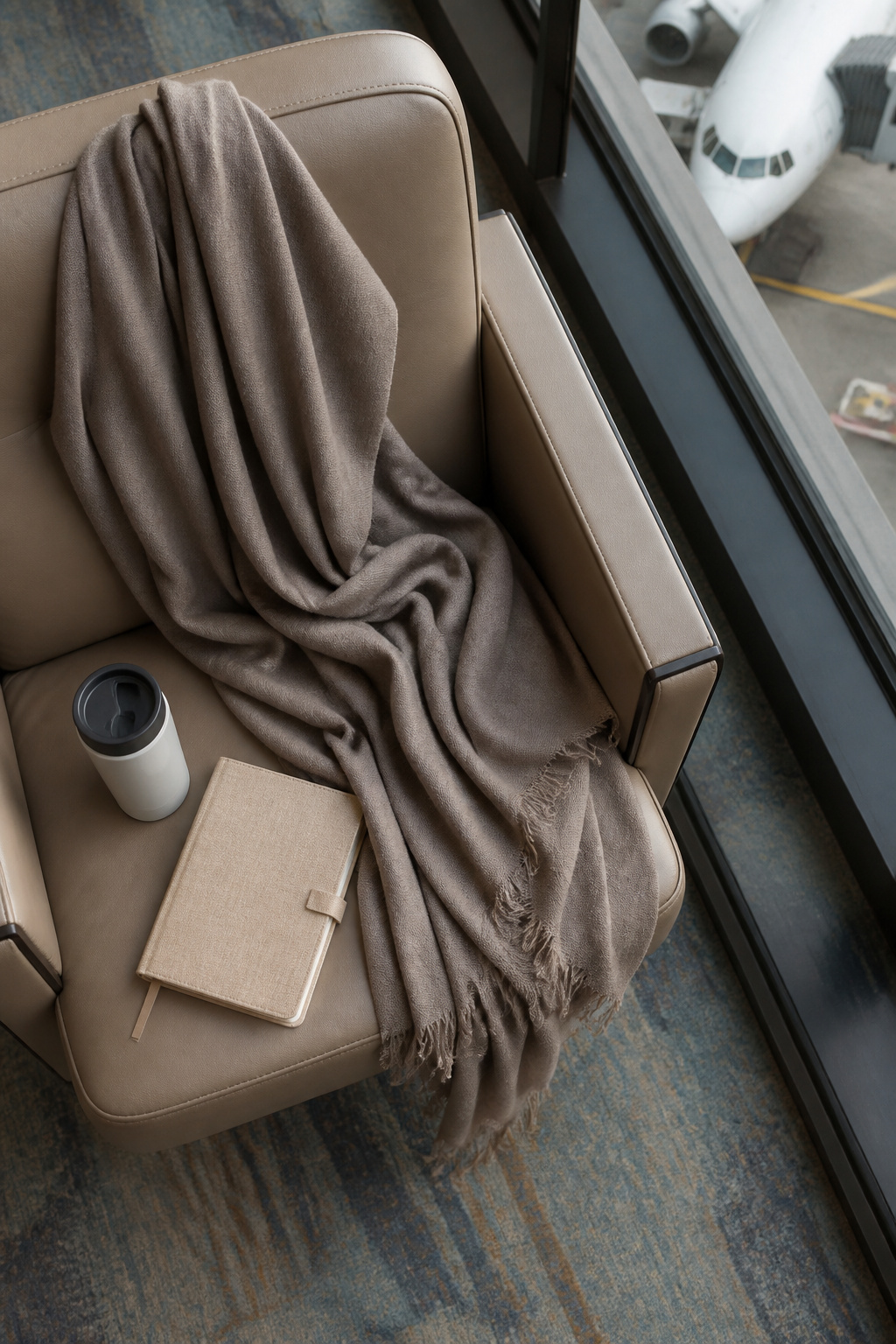
A travel wrap that drapes like a blanket, ties like a scarf, and layers like a cardigan solves most in-flight temperature problems without adding bulk to your bag. The cabin runs hot during boarding, then glacial once airborne, and a wrap adapts faster than any fixed layer you could pack.
Size matters more than fiber content. Look for something oversized enough to tuck around your legs or fold into a pillow, with enough weight to read as outerwear once you land. The wrong fabric clings with static the second you pull it over a knit top, so test the drape against synthetics before committing.
Cashmere wears beautifully and softens with use, though the investment stings on first purchase. A budget-friendly alternative in a dense cotton-wool blend can perform the same triple duty if the cut is generous and the weave has heft. Either way, neutrals earn their keep: oatmeal, charcoal, or camel works over a black tee, a striped shirt, or a travel dress without demanding coordination at 6 a.m. in a departure lounge.
The real value shows after landing. Draped over shoulders with a belt, the same piece reads intentional enough for dinner reservations while your actual jacket stays folded away.
7. Compression Socks

Sitting still for more than four hours lets blood pool in the lower legs, which is why ankles swell and feet ache on long flights. Compression socks counter that by adding graduated pressure, tighter at the ankle and looser up the calf, to keep circulation moving. The Comrad Knee-high compression socks run 5–20 mmHg, a range that hits the sweet spot for travel: enough to cut swelling and discomfort without feeling like medical gear.
With 5-20 mmHg of compression, Comrad’s socks are great for improving circulation and cutting down on the pain and swelling that can occur on long flights, and they’ve worked like a charm so far.
That pressure rating matters because too little does nothing and too much turns a flight into a wrestling match with your own clothes. What changed my mind about compression socks was discovering they no longer come in clinical beige alone. Black, navy, and subtle patterns now pair cleanly with sneakers or loafers, so the socks read as intentional rather than prescribed. For anyone who has landed with puffy ankles and stiff calves, the small step of pulling on a knee-high pair before boarding is the cheapest upgrade in a travel outfit.
8. Reliable Luggage

The Away Bigger Carry-On is the largest size that still fits most overhead bins, and that single fact reshapes your whole travel outfit. When a bag rolls straight onto the plane with you, there is no sprinting to the gate to beat the vultures to overhead space, no standing at baggage claim in shoes you regret, no contingency planning for a lost suitcase. Kayla Becker, a carry-on-only traveler, packs up to two weeks of clothes into this one hard-shell case and pairs it with the Everywhere Tote as her personal item. The tote straps over the suitcase handle, zips shut, and slides under the seat with a laptop inside. That two-bag system means you dress for the flight itself, not for the chaos before and after it. You can wear the soft pants and the shoes that slip off at security because you are not lugging, heaving, or rushing. The luggage does the work, and your clothes get to be comfortable.
9. Travel Essentials

A travel pillow that actually supports your neck changes whether you arrive functional or furious. The ones worth packing have some structure to them, not the inflatable doughnuts that let your head loll forward the moment you doze off. Memory foam with a raised front edge keeps your chin from dropping, and a flat back panel matters if you already layered a hoodie or jacket collar that pushes a bulky pillow forward.
Heat patches sit lower on most packing lists, but a stiff back at 30,000 feet turns a four-hour flight into a week of recovery. The adhesive kind that sticks to your skin or the inside of a layer works better than the belt versions, which shift every time you recline. Slap one on over a thin tee or directly against a camisole, then build your sweater and wrap on top so the warmth stays trapped rather than drifting into the cabin air. The patch lasts six to eight hours, which covers most domestic legs plus the slog through baggage claim.
These are the items that let the clothing do its job. A perfect travel outfit still fails if you land with a crick in your neck or a seized-up lower back, and these two are the cheapest insurance against that outcome.
Matching Sets

Coordinated tops and bottoms have become the quiet workhorse of any solid travel outfit. A matching set reads intentional at the gate while feeling essentially like loungewear once you are settled into 22C. The Spanx AirEssentials line was built for this exact crossover: their zip-up hoodie and the matching pull-on pants share the same soft, stretchy fabric that does not cling after hours of sitting, and the clean lines keep the look polished enough for a coffee stop during a layover. For a step up in material, the Jenni Kayne cashmere hoodie layers neatly over its coordinating bottom with that same ease but a different texture. What actually sells me on sets for early flights is the decision-making, or rather the end of it. At 5 a.m., grabbing one matched pair means one less variable when your brain is still half in sleep mode. Varley and Frank & Eileen also cut reliable travel sets if you want to compare fabric weights before buying, though the triple fleece in the Frank & Eileen runs warmer than the AirEssentials knit.
What I Wear on a Long Flight

The joggers-plus-sweater-plus-sneakers formula works, but the order I put it on matters more than the pieces themselves. For a 6 a.m. departure, I start with the sneakers first: New Balance 327s or Adidas Sambas, socks already on, because the security line is inevitable and fumbling with laces at 5:15 a.m. is not how I want to begin a travel day. The joggers go on next, then the sweater, since the airport warms up once you are moving but the plane will not.
A red-eye reverses that logic. The sweater goes on before I leave the house, worn as the outer layer from the start, because I will be asleep before the cabin crew finishes drink service and I do not want to dig through a bag for warmth at 30,000 feet. Sneakers stay the same, though I have switched to Kiziks for late-night departures; no laces to deal with when I am half-awake and the TSA agent is waiting.
The bomber jacket over a white tee and polished black pants is the alternative I keep in rotation when I need to land and go straight to dinner. It reads intentional, not comfortable, which is sometimes the point. The tee-and-bomber combination layers easily under the same sweater if the plane runs cold, so I am not gambling on one outfit for two temperatures.
Shoes That Walk All Day

A shoe that works for travel has to clear two very different jobs: the airport sprint and the all-day walk at your destination. The pair I trust does both without making me think about my feet, which is the real test. Slip-on construction matters most at security, where lace-up sneakers turn a two-minute shuffle into a held-up line and a scramble to retie while holding your bag, your phone, and your coffee. Loafers, clogs, or lace-free designs let you step out and back in without using your hands.
Cushioning is the other non-negotiable. Terminal floors are concrete, and a three-hour layover walk will expose any shoe that only looks comfortable. I check arch support by wearing a new pair on a full day of errands before it ever sees a suitcase. If I notice the shoes by hour four, they stay home. The ideal travel shoe also has enough structure that you do not look like you are heading to the gym when you are actually heading to dinner. A slightly retro sneaker or a clean loafer bridges that gap without trying hard.
Why Compression Socks Matter

Compression socks start at 15–20 mmHg for travel, enough to keep blood moving without feeling like a medical device. The 5–20 mmHg range works for shorter legs of a trip, though I notice the lower end does less on flights over ten hours. Put them on before you board, not after swelling starts; once fluid pools in the ankles, the sock is fighting uphill. I keep mine on through landing and until I’ve walked a bit at the destination, usually two to four hours total.
The first long flight I skipped them, my left ankle puffed enough that my sneaker laces strained by hour twelve. The first flight I wore them, same route, same seat, no puff at all. That single test sold me, though pregnancy later made the difference even sharper. Swiftwick and Bombas both run thinner and more breathable than the stiffer pairs I tried first, which matters when your travel outfit already layers up for a cold cabin.
Building a Layering System

The real test of a travel outfit is whether you can adjust it without opening your bag. I start with a short-sleeve tee, add a lightweight sweater, then a bomber jacket, and finish with an oversized wrap. Each piece needs to work on its own, because you will peel them off one by one.
At a 55-degree gate, the sweater plus jacket is usually enough. The wrap stays folded until the plane, where 72 degrees can still feel cold against the window. Draped over the shoulders, it solves most in-flight temperature swings without looking like you brought bedding. I skip anything with excessive buttons or hardware; layers you can pull on and off in a cramped seat are the ones that earn their space.
Landing in a 45-degree city, the jacket and wrap together do the work of a coat. The wrap also reads as a scarf once you are outside, which means the outfit still looks intentional while you are waiting for a ride. A neutral, oversized wrap covers about 90% of in-flight temperature issues, and it should look as good over your shoulders at baggage claim as it does in your seat.
Frequently Asked Questions
What should I wear on a long flight?
Wear comfortable clothes that layer well: joggers or wrinkle-resistant pants, a lightweight sweater, a white tee, and supportive sneakers that slip off easily at security. The exact order matters too, put on your sweater before a red-eye so you are not digging through a bag for warmth at 30,000 feet.
Are compression socks necessary for travel?
They are not mandatory, but they make a noticeable difference on flights over four hours. Graduated compression of 5–20 mmHg keeps blood moving and prevents the ankle swelling that can leave your shoes feeling tight by landing.
What are the best shoes for traveling?
The best travel shoes are supportive sneakers or clean loafers that handle two jobs: all-day walking and quick removal at security. Look for cushioned soles, arch support that lasts past hour four, and a style polished enough that you do not look like you are heading to a gym.