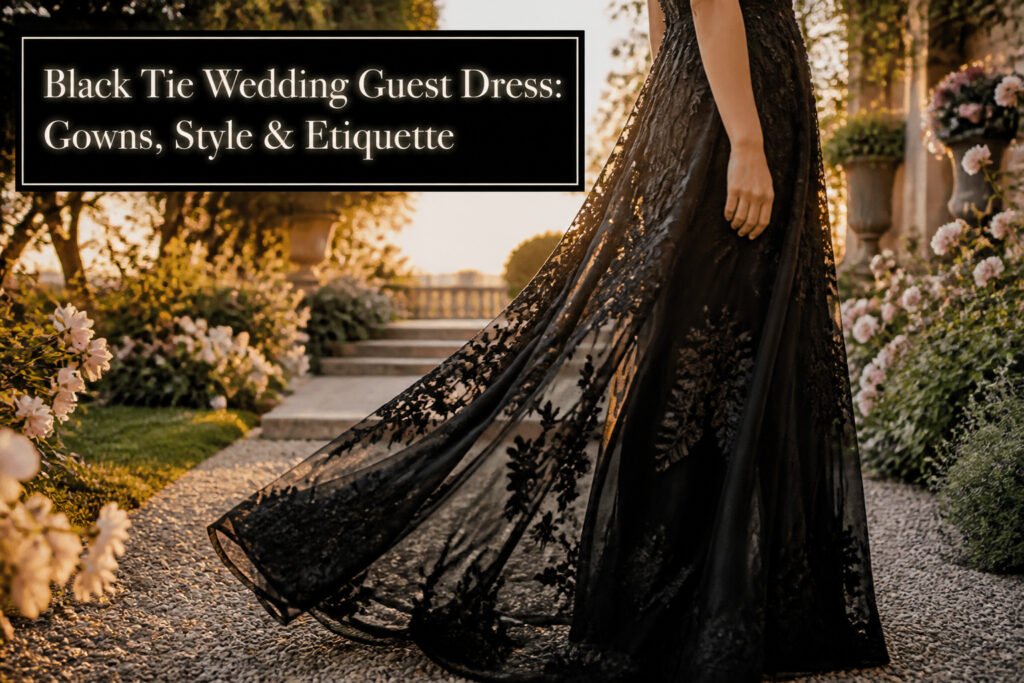
A black tie wedding guest dress is a full-length evening gown worn when an invitation specifies formal attire after 6 p.m. The catch is that anything shorter than floor-length risks reading as cocktail attire unless the fabric itself carries serious weight, like heavy silk faille or structured taffeta that holds its shape when you sit. I learned this in a Charleston hotel mirror, swapping a slim pantsuit that looked deposition-bound for a navy crepe jumpsuit with trousers that pooled over the shoe, the movement alone signaling evening rather than office.
Full-Length Gowns

A full-length gown is what black tie actually means: tuxedos for guests in suits, floor-length dresses for everyone else. When the invitation says black tie and you do not want to guess, this is the length that keeps you safe.
The hem should brush the floor, not drag behind you. I look for fabric with enough weight to fall straight; lightweight chiffon floats up and shows ankle, which reads casual in a room where nobody else is showing leg. A heavier crepe or drapey satin stays where you put it and skims the shoe without pooling.
For a formal event, a full-length gown is the standard. Anything that hits above the knee would be a cocktail dress better suited for a slightly less formal event.
That said, calf-length can work if the dress is otherwise formal; it is not the default, but it is the floor you should not drop below. As for body type, the column of a long dress lengthens a shorter frame and balances broader shoulders on an inverted triangle. The trick is in the waist seam placement: too high and it shortens the torso, too low and the legs disappear.
Embellished Dresses

Embellishment is expected at black tie, not something to shy away from. Beading, sequins, and lace overlays all read correctly for the dress code, though the trick is wearing enough to look formal without looking like you’re trying to outshine the couple.
A fully beaded navy gown I wore to a cousin’s wedding two years ago felt right the moment I walked in. The beads caught candlelight during dinner without flashing under it, and the dark base kept the whole thing grounded. A champagne sequin dress at a different wedding felt wrong from the start; the color plus the shine read celebratory in a way that pulled focus, and I spent the evening slightly self-conscious.
Dark colors with embellishment carry more weight than bright colors with identical detail. A black gown with scattered beadwork at the neckline reads formal and restrained. The same beadwork on coral or mint reads festive, which edges toward party dress territory rather than black tie. For a wedding guest, that distinction matters.
Tea-Length Dresses

A tea-length black tie wedding guest dress works only in narrow circumstances, and I treat it as the exception it is. Black tie optional events, daytime ceremonies, or venues with steep stairs or tight aisles sometimes call for a hem that clears the floor. Even then, the fabric and cut have to do heavy lifting. A full skirt in heavy silk, structured taffeta, or dense lace reads formal where lighter materials would look like you simply showed up underdressed. I always check the invitation wording twice before deciding. "Black tie preferred" or "creative black tie" leaves the door cracked; "black tie" without qualification usually does not. The risk is real. A tea-length hem can scan as cocktail attire in a room of floor-length gowns, and no amount of expensive fabric fully closes that gap. If I am uncertain, I default to full length and sleep better for it.
Dressy Jumpsuits

A wide-leg cut in a heavy fabric is what separates a black-tie jumpsuit from something you’d wear to a Tuesday meeting. I learned this the hard way at a noon wedding in Charleston where the bride had specified "creative black tie." My first instinct was a slim black pantsuit I already owned. In the hotel mirror, it looked like I was heading to a deposition.
The replacement was a navy jumpsuit with a structured, almost corseted bodice and trousers that pooled slightly over the shoe. The fabric had weight to it, a matte crepe that moved like liquid when I walked. That movement read as evening, not office. A satin or velvet works the same way; anything with a sheen or drape that catches candlelight.
What nearly ruined it was the shoe. I had packed a low block heel that disappeared under the wide leg and made me look truncated, almost like I was standing in a hole. Switching to a pointed-toe pump with a three-inch heel gave the pant enough lift to break cleanly and added the vertical line the outfit needed. The pointed toe also peeked out just enough to look intentional when I sat.
For daytime black tie, a jumpsuit feels right because you can move, eat, and sit in grass without the logistics of a gown. The structure just has to be formal: a defined waist, a covered back, no spaghetti straps. Think tuxedo translated to one piece, not business casual with better jewelry.
Dark Color Palette

Darker colors read more formal because they absorb light rather than compete with it, which is exactly what you want when the dress code is black tie. Black, navy, gray, and burgundy are the classic choices that work regardless of season, and they leave the attention where it belongs: on the couple and the event itself.
Bright colors are the mistake here. I learned that the hard way with a coral gown that felt cheerful in the store and completely wrong once I walked into a candlelit ballroom full of midnight blues and wine reds. The photos still make me wince.
That said, you do not have to default to black. For fall weddings, jewel tones carry the same weight as those darker neutrals. An emerald gown I wore to an October wedding felt exactly right; the depth of the color kept it formal without blending into the sea of little black dresses. Summer black tie loosens slightly toward neutral tones, a champagne or soft taupe chiffon still reads elegant because the fabric and the cut do the heavy lifting. The rule is subdued, not seasonal.
Elegant Accessories

A black tie wedding guest dress deserves accessories that whisper instead of shout. I reach for a silk wrap in a tone that matches or deepens the gown’s color, never a pashmina with fringe that belongs at a fall barn wedding. The fabric should feel cool and heavy in your hands, something that drapes rather than clings when you throw it over your shoulders between the ceremony and the car.
For jewelry, I keep it to one focal point: either a pair of fine drop earrings or a delicate bracelet, rarely both. Well-made costume pieces from a line you trust will outshine a single real diamond paired with the wrong shoes. The clutch should be small enough that you’re forced to edit, structured so it doesn’t collapse against your hip in photos. Satin, beaded mesh, or a clean metal frame all work; a crossbody strap or anything that looks like it could hold a phone and keys for a Saturday of errands does not.
At a wedding in downtown Chicago two summers ago, I watched a woman in a beautiful navy crepe gown step onto the dance floor in white sneakers she had clearly brought for comfort. The shoes signaled that she had given up on the evening before it reached its peak, and guests noticed before the couple cut the cake. The right accessories finish the look; the wrong ones announce that you stopped trying.
Formal Shoes

Dress shoes are a must for a black tie wedding, not a place to test whether sneakers with a suit reads cool. The invitation says formal, and your feet need to agree.
For grass or outdoor ceremonies, a block heel around two to three inches keeps you above the lawn without sinking. Indoor floor venues can take a stiletto or something finer, though I never go above four inches for a wedding; you are standing through cocktails, dinner, and dancing, not walking a runway. Satin, velvet, or polished leather read correctly under evening light. Patent leather can work, but it catches flash photography in ways that read harsh, so I skip it.
Breaking them in matters more than the pair costs. I wear new formal shoes around my apartment for two or three evenings, thick socks on, to soften the back and find the rub spots before they find me on the dance floor.
When the venue is uncertain, I bring one backup pair: same color family, lower heel, block base. They live in the car or hotel room, and I have switched into them twice after arriving to find the lawn steeper than the website suggested.
Polished Hair and Makeup

Polished hair and makeup for a black tie wedding does not mean red-carpet glamour. The standard is intentional and finished: someone looking at you from ten feet away at the cocktail hour should see that you made an effort, not that you spent three hours in a chair.
What "finished" looks like shifts with hair type and the day’s schedule. My own routine for a 2 p.m. ceremony with an eight-hour reception runs about forty minutes at home: a smooth blowout with a large round brush, cream foundation that I set with powder at noon so it has time to settle, and a lip color I reapply after dinner rather than fuss with all night. The heat of a summer tent or the chill of a hotel ballroom both matter; a style that holds through one can flatten or frizz through the other.
I hire help when the timeline is tight, not when the dress is expensive. A 1 p.m. ceremony with photos starting at eleven leaves no margin for a curling iron mishap. For evening-only affairs where I can take my time, I do it myself and save the two hundred dollars for the shoes I’ll actually wear again. The real test is whether you can touch up in a bathroom stall without spreading product across your gown.
What Black Tie Means on an Invitation

A black tie wedding guest dress is not a suggestion; it is a requirement for evening events where the couple wants elegance, not convenience. The invitation will say so plainly, and that wording matters. Black tie means full-length gowns, polished dress shoes, and the level of formality most of us never touch on a Tuesday. Black tie optional loosens the expectation slightly: a tea-length or midi dress still reads appropriately, though an evening gown is what the hosts hoped for. Creative black tie, when it appears, invites personal interpretation within the same formal frame. I read the invitation twice, slowly, because the difference between these three phrases changes everything I pack.
Length and Style Compared

A full-length gown in a clean crepe reads differently than the same cut dripping in sequins, and the gap only widens when you crop the hem to tea length. The simpler the dress, the more the length carries the formality; the heavier the embellishment, the more a shorter hem starts to look like after-party attire rather than ceremony-appropriate.
| Style | Best venue match | Body shape note | Risk to avoid |
|---|---|---|---|
| Full-length, simple | Ballroom, cathedral, evening garden | Elongates petite frames; column cuts favor straighter hips | Reads plain in photos without jewelry |
| Full-length, embellished | Grand hotel, museum, any venue with dramatic architecture | Structured bodices define waist; heavy skirts balance broader shoulders | Overwhelms at intimate gatherings under 75 guests |
| Tea-length, simple | Vineyard, upscale restaurant, daytime ceremony | A-line skirts add volume to narrow hips; defined waist helps | Can look like a cocktail dress that missed the memo |
| Tea-length, embellished | City loft, art gallery, modern space with mixed lighting | Vertical beading lengthens; avoid horizontal bands at mid-thigh | Too many competing details with statement shoes |
The combination that surprised me most, paging through wedding albums, was tea-length with minimal detail: it only works when the fabric itself is substantial, silk faille or heavy satin that holds its own shape. Anything lighter and the dress collapses into semi-formal territory the moment the wearer sits down.
What Not to Wear

White at a wedding still reads as a breach, and at black tie the stakes are higher because everyone photographs well in formal light. The rule extends past color into cut and construction. A gown that would draw your eye at the altar during the vows is the one to leave in the garment bag. I run that check in the fitting room: if I imagine the ceremony shot and my dress seizes focus from the couple, it is too much. Sheer panels, extreme leg slits, or a train that pools like a bridal veil all fail this test. Ball gowns belong to white tie, not here, and a top hat with tails risks outdressing a groom in a standard tux. The couple paid for the spotlight; the guest’s job is to look excellent without becoming the memory.
Dressing for the Season

A black tie wedding guest dress in velvet or heavy crepe reads correctly in November, while the same silhouette in silk chiffon would look stranded indoors. Season sets the fabric grammar before color even enters the conversation. Fall and winter call for weight: duchess satin, brocade, dense jersey that holds its shape against a coat. Spring and summer lighten to matte crepe, fluid georgette, or a lined lace that breathes. The palette follows the same logic. Deep jewel tones, aubergine, forest green, and midnight navy feel at home when the sun sets early; warm-weather black tie leans into softer territory: champagne, dove gray, dusty rose, a quiet slate blue that photographs well in harsh afternoon light.
I own one black gown that has carried me through four seasons, and the cover-up does almost all the seasonal work. In December I add a cropped fur bolero and wear it with closed-toe velvet pumps. Come April, the same dress loses the fur, gains a pashmina in pale blush, and the shoes switch to strappy sandals. June calls for nothing heavier than a silk organza wrap in ivory, kept in my clutch until the church air conditioning kicks in. The accessories rotate; the dress stays constant. That is the practical case for buying one excellent black gown rather than chasing four trend-driven colors.
Frequently Asked Questions
What is appropriate attire for a black tie wedding?
A full-length evening gown is the standard for women, paired with polished dress shoes and elegant accessories. The dress code means exactly what it says: floor-length, formal fabric, and the level of dress most people never wear on ordinary days. Anything shorter or more casual risks looking underdressed in a room where everyone else followed the instruction.
Can I wear a tea-length dress to a black tie wedding?
A tea-length black tie wedding guest dress only works in narrow circumstances, such as black tie optional events, daytime ceremonies, or venues with difficult stairs and aisles. Even then, the fabric must be heavy and formal, a full silk skirt or structured taffeta rather than anything lightweight. If the invitation says plain black tie without qualification, default to full length rather than risk looking like you missed the dress code entirely.
What colors should I avoid for a black tie wedding?
Avoid bright colors and white; darker tones absorb light rather than compete with it, which keeps attention on the couple. Black, navy, gray, and burgundy are the classic choices year-round, with deep jewel tones like emerald working for fall. A coral or mint gown reads festive rather than formal, and white still breaches wedding etiquette no matter how elegant the cut.