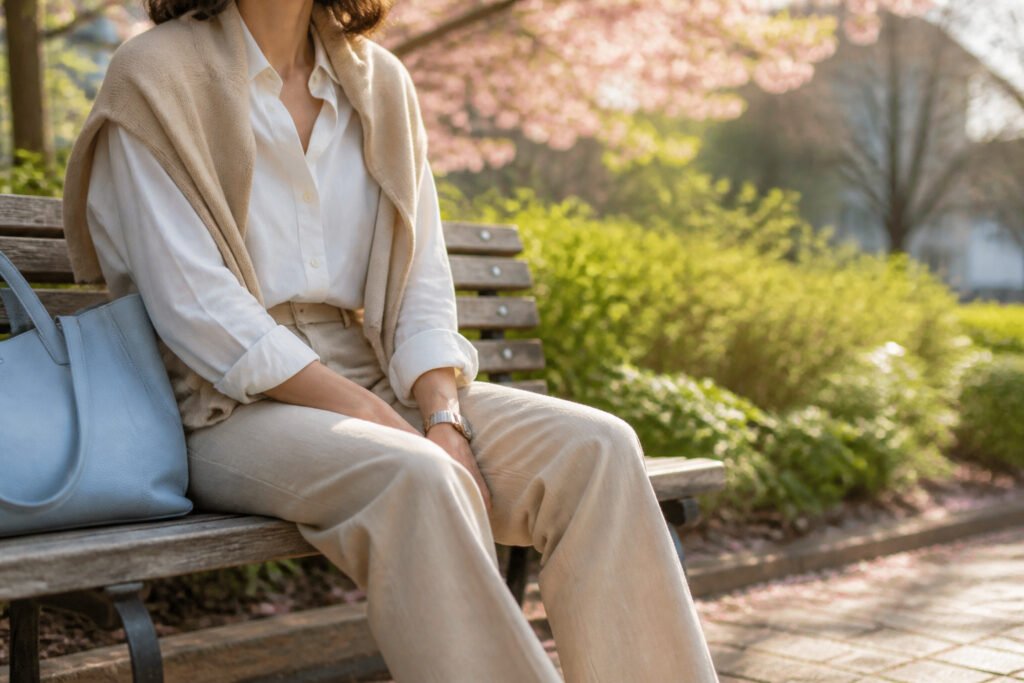
A spring business casual outfit is what gets you through days that start at 52°F and hit 72°F by lunch. The trick is building in layers that look intentional even when you take them off, and choosing fabrics heavy enough for fluorescent AC but light enough for a warm walk to the parking garage. A mid-weight linen around 7–8 oz holds enough structure for a conference room without feeling like canvas, and a tan sweater over a white blouse handles the commute while the blouse alone carries the afternoon.
White Blouse, Tan Sweater, Black Jeans, Loafers

A tan sweater layered over a crisp white blouse hits that middle ground spring offices demand. The sweater comes off by 10 a.m. most days, but those first forty-five minutes at a desk can still feel like winter. Dark-wash black jeans keep the look pulled together in ways lighter denim never quite manages; the deep color reads intentional rather than weekend. Loafers finish it because they split the difference almost perfectly: closed toe and structured enough for meetings, flat and walkable enough for parking garages.
I have worn this exact combination on mornings that started at 52°F and hit 72°F by lunch. The sweater handles the commute, the blouse alone handles the afternoon, and neither layer looks wrong if you carry the sweater draped over your arm through a warm afternoon meeting.
Striped Sweater, White Pants, Flats

White pants in the office read as spring because they carry the season’s light back into a building that still runs on fluorescent bulbs. The trick is keeping them clean through April, when the sidewalk alternates between pollen dust and sudden rain. I keep a compact umbrella in my desk drawer, not my bag, so I’m never caught deciding between a damp commute and looking like I dressed for August in January.
Stripes on the sweater add just enough pattern to keep the outfit from feeling like a uniform. Thin navy or charcoal lines against cream work better than bold color blocks here; the eye reads them as texture, not statement. A crewneck or shallow V-neck sits cleanly under a blazer if someone schedules a last-minute client meeting.
The flats matter most for keeping this weekday-appropriate. A pointed toe or minimal hardware, something in leather with a structured heel cap, signals intent. Soft ballet slippers or anything with a bow tip the look toward brunch. I have one pair of bronze loafers with a low vamp that I reach for here; they match the pants without matching too hard, and the metallic reads as deliberate rather than casual.
April rain will spot white cotton-blend pants in under a block, so I check the hourly forecast before committing. A cropped or ankle-length cut helps, less fabric to drag through puddles, and it shows the shoe rather than pooling around it.
Button-Down Shirt, Maxi Skirt, Belt, Flats

A button-down shirt tucked into a maxi skirt that hits just at the ankle bone reads as office-appropriate rather than resort-wear. The crisp collar and straight placket borrow from menswear, while the skirt’s volume keeps the look from feeling like a uniform. Without a belt, the silhouette can swallow your shape; a narrow leather band at the natural waist pulls the eye inward and keeps the proportion intentional.
I learned the hard way that midi-length maxis, the ones that pool around the calves, drag the eye down and read as sloppy in a conference room. The ankle-grazing length, on the other hand, skims cleanly over flats and still looks polished when you’re seated. A pointed-toe flat finishes the line without competing for attention.
Crewneck Sweater, White Tee, Linen Pants, Flats

Linen wrinkles the second you sit down, which used to keep me away from it until I noticed how many women in my office wore it anyway and looked perfectly put-together. The creases read as texture, not sloppiness, especially in a tailored cut with a sweater layered on top to anchor the look. A mid-weight linen, around 7–8 oz, holds enough structure for a conference room without feeling like canvas. Anything lighter drifts toward beach territory; anything heavier defeats the point of spring dressing.
I reach for oatmeal linen first every April. It pairs cleanly with white, softens the contrast against a cream or camel crewneck, and forgives a coffee drip better than stark white pants ever will. This outfit lives between 60 and 72 degrees. Below that, the sweater carries you; above it, you lose the layer and the tee breathes on its own. Flats keep the whole thing grounded, literally, for a day that moves between desk, coffee run, and the parking garage stairwell when the elevator line is too long.
Oversized Blazer, T-Shirt, White Pants, Loafers

An oversized blazer over a plain t-shirt with white pants and loafers reads as intentional rather than lazy, which is the whole point of spring business casual. The blazer does the heavy lifting: its structure and length signal that you planned the outfit, while the t-shirt underneath keeps it from feeling like you’re playing dress-up in someone else’s clothes. Oversized means the shoulders still sit at your shoulder line and the sleeves hit near your wrist bone; anything past that is just ill-fitting, and the difference shows in photographs and in person.
I have worn the same wool-blend blazer from Everlane through three springs now. The fabric relaxed slightly after the first dry clean but never bagged at the elbows or lost the shape through the waist, which is where cheaper versions tend to give out first.
Loafers finish this better than sneakers would. A leather loafer has enough formality to match the blazer’s authority, while a running shoe or canvas sneaker pulls the eye downward and starts a fight between top and bottom that the outfit does not need. White pants in spring already draw attention; let the loafers anchor them quietly.
Short-Sleeved Sweater, Pencil Skirt, Trench Coat, Slingback Heels

A short-sleeved sweater with a pencil skirt hits that middle register where you look dressed for work without looking dressed for winter. The sweater keeps your arms free for the first warm afternoon, and a second sweater tied at the shoulders handles the conference room that still thinks it’s February. A trench coat at knee length or just below flatters most body shapes without swallowing your silhouette the way a full-length coat can.
Slingback heels earn their place in this outfit because boots feel clunky once the mercury climbs past sixty, and open sandals still draw side-eye in plenty of offices. The slingback keeps your heel anchored while letting some air move through. I have found that a two-and-a-half to three-inch heel is the ceiling for all-day wear; anything taller and I’m hunting for flats by three o’clock. Gold knot earrings finish the look without competing with the clean lines of the trench and skirt.
Shirtdress, Mules
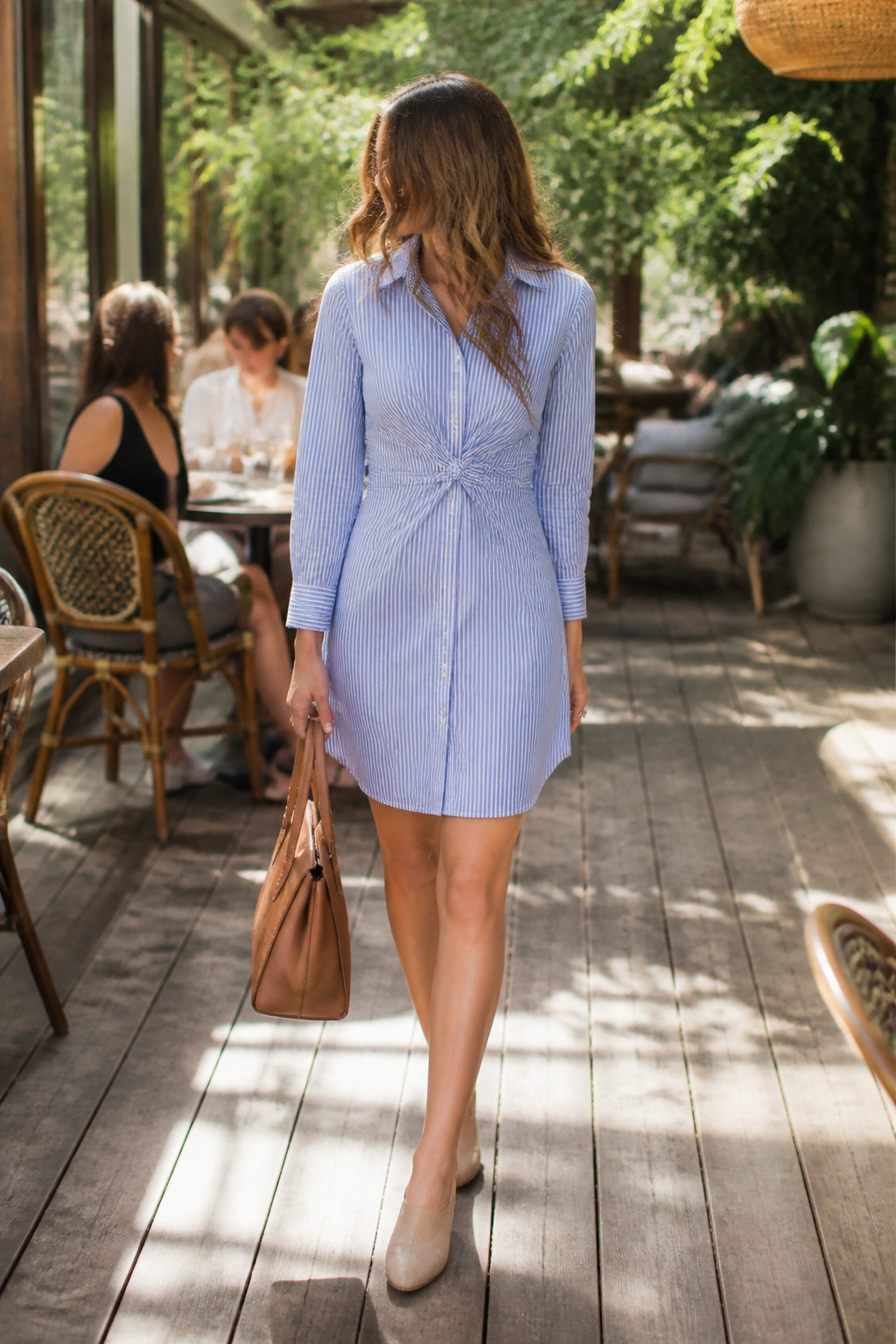
A shirtdress with mules is the closest thing to a complete spring business casual outfit in one piece. The distinction matters: a true shirtdress has a full button placket, a collar, and a hemline cut with actual dress proportions through the hips and seat. Wearing an oversized shirt as a dress usually gaps at the chest or rides up, and in an office, that reads as something you grabbed from the laundry pile.
Mules keep the look professional where slides fall short. The backless cut of a mule still shows structure in the toe and heel, while slides look poolside no matter what leather you use. A closed-toe mule with a modest heel, one to two inches, stays office-appropriate without the commitment of a full pump.
Fabric choice decides whether you freeze by 10 a.m. in AC set to 68°F. A cotton poplin or lightweight wool blend holds enough body to look intentional; a rayon challis or thin jersey clings and chills. I once bought a shirtdress in a watercolor floral that seemed polished online. In person, the print read vacation, and I never wore it to the office. Solid navy, olive, or a narrow stripe travels farther than anything that looks like it belongs at a garden party.
Denim Jacket, T-Shirt, Black Jeans, Mary Jane Flats

A dark, structured denim jacket with minimal fading pulls this outfit away from Saturday morning territory. The wash matters more than most people expect: deep indigo or a clean black denim reads as outerwear, while anything distressed or acid-washed signals weekend regardless of what sits underneath. I pair mine with a fitted crewneck tee in white or cream, tucked into black jeans that are slim or straight through the leg. Skinny cuts can tip the look toward casual, and wide-leg black denim needs a heel to keep proportions office-appropriate.
Mary Jane flats anchor this formula when they carry actual structure. A rounded toe, a single strap, and a leather sole that clicks slightly on hardwood separate them from ballet-flat territory. I have resoled the same pair twice, which says something about how often I reach for them and how much I would rather repair than replace. The cost of resoling runs about a third of replacement, and the leather upper softens to your foot in a way new pairs simply do not.
Not every office permits denim, and the ones that do usually mean the jacket, not the jeans underneath. I test the boundary by wearing the full combination on a Friday first, or on a day with no client-facing meetings, and I watch whether anyone senior comments. Twice I have left the jacket draped over my chair and worn just the tee and black jeans, which passed without notice in places where the jacket would not have.
Midi Dress With a Cardigan or Blazer

A midi dress handles the spring tights problem by simply removing it. The hem hits between the knee and mid-calf, so bare legs look intentional rather than underdressed, and a light cardigan in cotton or a fine-gauge knit keeps you warm through a 60-degree morning without the bulk of winter wool. Swap that cardigan for a structured blazer, and the same dress reads sharper for a meeting or a client lunch. I bought one particular midi dress in both navy and rust for exactly this reason: the softer top layer works for desk days, the blazer for days when I need to look like I thought about it. The weight of the cardigan matters more than the color. Spring layers should feel like an afterthought, not armor.
Wide Leg Pants With a Fitted Top

Wide leg pants read as a column of fabric from hip to hem, which is why the top has to sit slim against your body to keep the silhouette from turning into a shapeless block. I learned that the hard way last spring when I tried a cropped boxy tee with high-waist navy trousers; the excess fabric at my waist and hips made me look like I was wearing a costume from a 1970s office sitcom. The fix was a fitted knit top tucked in with a half-tuck that stayed put through a full day of sitting and standing.
Wide leg is not flare. Flare kicks out below the knee; wide leg keeps the volume steady from thigh to ankle, so the hem width is your constant. That steadiness needs structure from the fabric itself. Linen and cotton blends with a touch of stretch hold the line without turning stiff, and they breathe when a spring morning turns into a warm afternoon. A pointed-toe flat or a low slingback keeps the foot narrow and the leg line uninterrupted, which matters more here than with a tapered pant because there is already so much horizontal width at the bottom.
Tailored Pants With a Lightweight Blazer

A spring-weight blazer starts with the fabric, not the label. I look for roughly 250–280 grams per square meter in wool or a wool-linen blend; anything heavier than 320 grams traps heat once the afternoon sun hits, and anything under 200 grams wrinkles before lunch. The lining matters almost as much. A half-lining, or none at all, lets air move through the back and sleeves where you actually sweat. Fully lined blazers belong to January.
Color is where the outfit sheds its winter skin. Navy still works, but pair it with stone or warm gray trousers rather than black. A soft camel blazer over ivory pants reads seasonal without trying too hard for pastels. I skip the heavy charcoal combinations that looked sharp in February; they absorb heat and look like you forgot to check the calendar.
For the transition to dinner, the cut does the work. A slightly shorter blazer, hitting at the high hip, looks intentional with the sleeves pushed up. Swap the daytime flats for a slim heel, add a pendant or small earrings, and the same pants carry you through. The lightweight construction means you are not peeling off layers at the restaurant; the outfit simply adjusts.
Colored Pants With a Neutral Top

Spring colors in pants only work at the office if the saturation stays low enough to read as intentional, not playful. Sage, rust, and anything navy-adjacent carry the same weight as traditional neutrals once you pair them with a quiet top. Hot pink or lemon yellow, even in tailored cuts, tend to signal vacation first and make you fight uphill for credibility in a meeting.
I started with one pair of rust trousers three years ago, worn almost weekly with an ivory silk shell and a camel crewneck when the mornings stayed cool. The combination got me through a full day of presentations without anyone commenting on the color, which is exactly the goal. Now I own the same cut in sage and a slate-blue that sits right between navy and gray.
The neutral tops I reach for are narrower than you’d expect: off-white or cream rather than stark white, which softens the contrast; camel or light gray knits; and one charcoal short-sleeve sweater for days when I need the pants to do the only talking. A true black top against rust reads too harsh for spring mornings, so I skip it until fall.
Cardigan Over a Tank Top With Tailored Pants

A tank top under a cardigan beats a tee for spring office days because the line stays cleaner and the bulk disappears. When the sidewalk hits 78°F and the office is still set to 64°F, that slim layer means the cardigan comes off without a rumpled base underneath. I keep one in my desk drawer now after too many afternoons of looking like I’d slept in my shirt.
Cardigan length matters more than most people notice. Hip-length or just below works with tailored pants; anything longer starts to read as loungewear unless the pants are cropped and slim. I learned that the hard way in a meeting where my knee-length cardigan made the whole outfit feel like I’d given up. With pants, you want the cardigan to hit where a blazer would, somewhere near the pocket line, so the silhouette stays intentional rather than apologetic.
Layering for Unpredictable Weather

Spring weather can swing forty degrees before lunch, and business casual layers are what keep you from looking either underdressed or overdressed. A lightweight blazer, a fine-gauge cardigan, and a printed scarf are the three pieces that actually earn their keep in an office bag. Each one reads as intentional when worn and folds small enough to tuck into a tote or drape over a chair without drama.
The blazer should be unlined or half-lined, nothing with heavy shoulder padding that turns into a sauna by noon. A cardigan in a thin knit works tied over the shoulders for that Parisian touch the sources mention, or pulled on if the AC is set to arctic. A scarf adds color without commitment and comes off the moment the sun hits.
Last April there was a day that started at 45°F at 8 AM and hit 80°F by 3 PM. I had on a white popover blouse, black jeans, and a tan sweater layered over my shoulders. The sweater came off by ten, the blazer I carried stayed in my bag until the afternoon meeting, and the scarf I looped at lunch was in my tote by two. Nothing I wore looked like I had dressed for two different seasons; it just looked like I had dressed for the day I got.
Breathable Fabrics That Hold Their Shape

Cotton, linen, and chiffon each have a place in spring business casual, but the weave and weight decide whether you look polished or like you walked off a resort dock. I check fabric tags for the grams per square meter or, on American labels, the ounces per yard. A cotton poplin around 120 gsm has enough body to hold a crease through a morning of meetings without turning clammy by afternoon. Anything lighter than 100 gsm and the shirt starts to look like an undershirt by 2 p.m.
Linen is the fabric I get asked about most. It breathes better than almost anything, which is why I keep reaching for it, but it wrinkles the instant you sit down. A 100% linen blazer looks crisp for roughly fifteen minutes. I won’t buy a linen blend below 55% linen because at that point the synthetic fiber takes over and you lose the cooling point of wearing it at all. A 70/30 linen-cotton mix gives me the texture I want with wrinkles that look relaxed rather than slept-in.
Chiffon is trickier. It floats and catches light beautifully, but it is transparent in direct office lighting. I always plan for a camisole or a full slip underneath, and I test it in daylight before committing. The extra layer sounds like hassle, yet it is what lets a chiffon blouse read as intentional rather than accidental.
Spring Colors and Patterns

Lighter colors read as spring without the risk of looking like you wandered off a patio. A soft sage or dusty blue jacket over your usual neutrals signals the season without shouting. Brights are harder to control; a coral pump or butter-yellow belt works, but a full fuchsia suit tends to own the room in ways most offices do not reward.
Floral scale matters more than color. A blouse with a print the size of a quarter looks busy and cheap from three feet away. Palm-sized blooms or smaller, spaced with breathing room, read as intentional rather than accidental. I ordered a floral blouse last March that looked refined on the model, but the petals were large as my hand and the effect was pure garden party. It went back the same week. The replacement was a navy shell with scattered pin-dot flowers no bigger than my thumbnail, and that one stayed in rotation through June.
Stripes remain the safest pattern for anyone unsure. A narrow stripe on a cotton button-down or a soft sweater reads as classic, not seasonal, so the piece earns its keep past May.
Shoes That Work All Day

Loafers, flats, mules, slingbacks, and ankle boots each carry a spring business casual outfit differently, and the difference shows up around hour six. A one-inch heel is my ceiling for days that involve actual walking between buildings or standing through a presentation; anything taller lives in my bag for the commute or stays home. The pair I have resoled twice is a block-heel loafer from a brand that starts around $180 and runs narrow, which matters if you are sizing for socks in March and bare ankles by April.
The transition from winter boots without freezing means keeping ankle boots in rotation through mid-April, not swapping everything overnight. A sleek almond-toe boot in smooth leather reads more polished than lug-sole styles and pairs with the same trousers you will wear with loafers in May. I keep a thin merino sock in my desk drawer for mornings that start below forty; by ten o’clock, the boot works without it.
Mules and slingbacks look right once the sidewalk salt is gone, but a backless shoe on a wet April morning is a mistake you make once. Flats with a pointed toe elongate a cropped pant the same way a heel would, and the ones with a leather sole rather than rubber feel more intentional under a blazer. My limit for a flat is no padding that compresses to nothing by noon; a removable insole lets you replace it instead of replacing the shoe.
From Desk to Dinner

Most spring business casual outfits already carry enough polish to walk straight into a restaurant without stopping home. The shirtdress and mules, the tailored pants with a lightweight blazer, the midi dress under a cardigan: these need nothing extra. The denim jacket look and the crewneck sweater with linen pants sit at the casual edge, so one swap moves them across the line. Usually it is the shoe. A mule or slingback heel replaces a flat, or a loafer steps in for a sneaker. Jewelry runs a close second: swapping small studs for a slightly longer earring catches light differently after six o’clock. Lip color works in a pinch when the bag is small.
I keep a slim pouch in my work tote with exactly this in mind. Last month I went straight from a full day of meetings to a birthday dinner at a small Italian place downtown. I was wearing the striped sweater and white pants with tan flats, which felt too literal for evening. I ducked into the restroom, changed into black slingbacks I’d folded flat into the pouch, and added a brick-red lip tint I keep in the same pocket. The pants and sweater needed no alteration. The whole switch took three minutes, and I sat down without that rushed, still-at-work feeling that usually follows me through the door.
Frequently Asked Questions
What are some cute spring office outfits?
A white blouse layered under a tan sweater with black jeans and loafers handles mornings that start at 52°F and hit 72°F by lunch. A striped sweater with white pants and structured flats adds just enough pattern without looking like a uniform. A shirtdress with closed-toe mules is the closest thing to a complete outfit in one piece, as long as the dress has actual dress proportions through the hips and seat.
Can I wear jeans to the office in spring?
Yes, if your office permits them. Dark-wash black jeans read intentional rather than weekend, especially with a structured top like a white blouse and tan sweater or an oversized blazer. The deep color and tailored fit separate office-appropriate denim from casual Friday territory. Test the boundary first on a day with no client-facing meetings if your dress code is unclear.
What shoes should I wear for spring business casual?
Loafers split the difference almost perfectly: closed toe and structured enough for meetings, flat and walkable enough for parking garages. Pointed-toe flats elongate cropped pants the same way a heel would. Slingback heels work once the mercury climbs past sixty, letting air move through while keeping your heel anchored. A one-inch heel is the practical ceiling for days with actual walking between buildings.