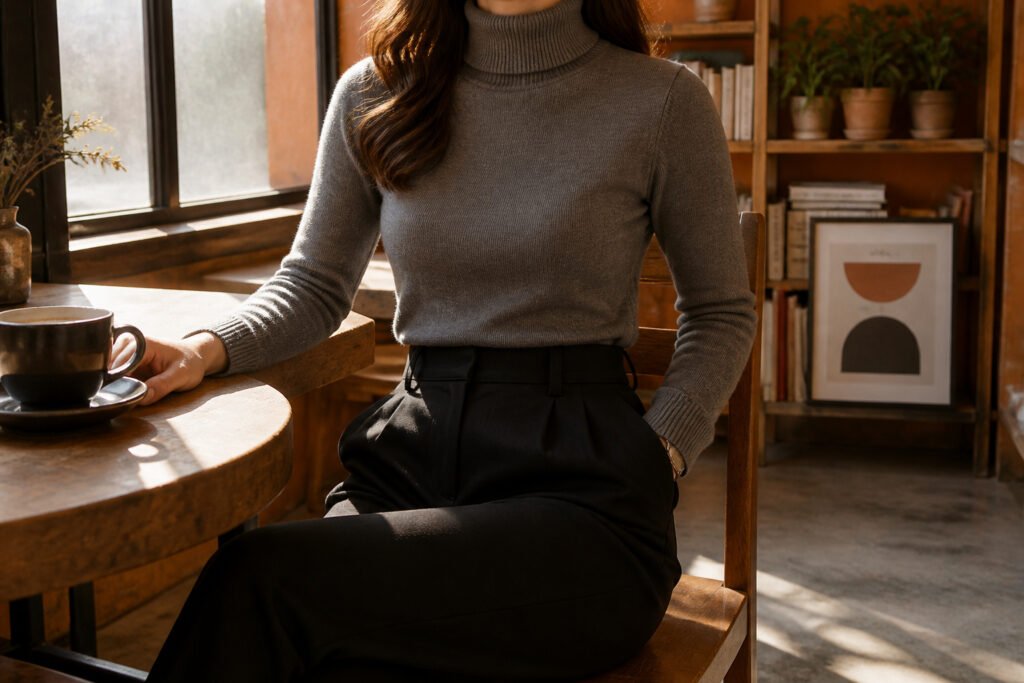
Winter business casual outfits are cold-weather combinations of tailored and relaxed pieces that keep a professional appearance through freezing commutes and overheated offices alike. The challenge is fabric weight: a cable knit that looks polished at home can bulk under a blazer into a snowman silhouette, and cotton base layers leave you damp by noon while merino handles the same commute without showing. A thin turtleneck in charcoal or black, skimming the torso without pulling, replaces the collared shirt entirely under wool tailoring and solves the 10 a.m. overheating problem that layered button-downs create.
Dark Wash Denim

Dark wash denim earns its place as a workwear workhorse when the dress code calls for winter business casual outfits. Multiple style guides name dark wash skinny jeans specifically as the most reliable silhouette for pairing with boots, though wider legs have taken over the trend conversation if that matters to your closet. The office-acceptable version requires two filters: no distressing, and no obvious fading. Reserve the ripped knees and whiskered thighs for Saturday. What remains is a foundation that handles a sweater and wool coat without looking like you grabbed weekend clothes in the dark. Straight leg and kick crop cuts work as natural next steps if you’re easing away from skinny fits, but the boot-tucking advantage still belongs to the narrower leg. The capsule wardrobe appeal is real here. Most women already own a pair that passes the test with a quick audit of the wash and the hem.
Black Pants

Black pants carry winter business casual outfits more reliably than almost anything else in the closet. I own them in skinny, straight, ponte, and paperbag cuts, and the silhouette choice mostly depends on whether I am pulling on boots that morning; skinny shapes tuck cleanly into shafted styles, while straight or wide legs need a different footwear plan but read as more current in open-plan offices. Matte faux leather and wool flannel both work, though the leather requires checking office culture first, and wool wins on genuinely cold commutes when thermal long johns underneath stay invisible. Color sits entirely in the shoes or the top layer; black on black with a single bright point somewhere above the ankle is the simplest formula I return to.
Wide Leg Pants

Wide leg pants have settled into my winter rotation after a season of trial and error. The extra fabric around the leg catches more air than a slim cut, which matters on a windy walk to the office, so a thin pair of tights underneath solves the chill without adding bulk. For texture, corduroy reads as intentional in a way flat wool sometimes doesn’t, and chino weights in winter twill hold their shape through a full day of desk-to-meeting movement.
The boot question took longer to sort. A slim shaft disappears cleanly under the hem; anything wider pools or drags. I keep the pant length just grazing the top of the boot so the line stays continuous from hip to floor.
Color runs the full range, though I reach for dark neutrals, olive, and camel most often. A wide leg in faux leather works if the finish is matte enough to avoid a costume effect, but I default to wool flannel or a brushed cotton when the office runs cold. The silhouette wants something fitted up top, a tucked sweater or a cropped blazer, to keep the proportions from swallowing the frame.
Turtleneck Sweater

A thin turtleneck sweater functions as the quiet workhorse of winter business casual outfits, solving the morning problem of what sits under a blazer without adding bulk. The J. Crew tissue turtleneck, mentioned often in workwear discussions, layers cleanly beneath tailoring because the fabric is light enough to avoid that stuffed-sleeve feeling at the shoulder seam. Worn alone, the turtleneck reads more polished than a crewneck while still delivering warmth across the collar and neck, which is usually the first place an office chill hits.
The styling choice that keeps this professional is fit control. A turtleneck with too much ease through the body looks like weekend wear; one that skims the torso without pulling acts as a stand-in for a blouse. Under a wool or knit blazer, the turtleneck replaces the collared shirt entirely, which matters on days when layering a button-down underneath would mean overheating by 10 a.m. The mock neck and crewneck options work similarly, but the full turtleneck carries more presence in a room where you are leading rather than participating.
Color discipline helps here. A black or charcoal turtleneck under a neutral blazer reads intentional; a bright or heavily patterned version starts to look like you are trying to make the sweater the outfit’s point, which shifts the tone toward casual. The balance to strike: the turtleneck provides warmth and a clean line, while the blazer still reads as the structured, authoritative piece. If the turtleneck peeks out at the wrist because the sleeve is too long, that detail undermines the polish, so checking sleeve length against your blazer before you leave the house is worth the thirty seconds.
Cable Knit Sweater

Cable knit sweaters sit at the center of most winter business casual outfits I see recommended, and the texture is exactly what makes them tricky. The raised pattern reads cozy, which is great, but it can tip into weekend territory fast if the weight is off. Mid-to-light weights layer cleanly under a blazer without the bulk that turns you into a snowman silhouette, and the smoother surface keeps the cable detail from overwhelming the rest of the look.
Crewneck pullovers are the safest silhouette here. Wear one as a standalone top with a structured trouser, or layer it over a crisp collared shirt so the collar and a half-inch of cuff give the knit some office context. Quarter-zip and v-neck cables exist, but the crewneck’s clean line is what most stylists reach for first. If your office runs formal, avoid the chunkiest fisherman weaves; save those for the commute and swap to a finer gauge once you’re at your desk.
Knit Blazer

A knit blazer lands softer than structured tailoring, which makes it the piece I reach for when the office thermostat wars start. The looser fit reads more casual, so it works layered over a tee or thin sweater on milder days but falls short under a wool coat when you need real architecture at the shoulders. Length changes the message: cropped sits best on petite frames and pairs cleanly with skirts, while long and oversized drapes read relaxed enough that I’d skip it for client-facing mornings.
Through a commute, fabric choice decides whether the blazer holds its shape or sags into a cardigan impersonation. Dense wool blends with a touch of structure built in recover better than pure cotton knits that pill at the friction points by week three. The ones that survive my rotation feel almost jacket-weight in the hand but still bend when I roll the sleeves.
Tailored Blazer

A tailored blazer in wool or a structured knit gives winter business casual its backbone, and the weight of the fabric matters more than most people notice until they’re shivering through a meeting. The blazer layers cleanly over tees, thin sweaters, silk tops, or button-downs, but it starts to fight you once the knit underneath gets bulky. I learned this the hard way: a cropped blazer that hit perfectly at my hips over a silk blouse rode up and puckered over a thick cable sweater, and the whole look collapsed into something too tight and too casual at once. Longer blazers that fall below the hip read more relaxed, which works for a Friday but not for the presentation you forgot about. If you’re also petite, hip-length or cropped tends to keep the proportions intact. The real test is the armhole: high and tailored, and you can fit a thin merino base layer or a fine-gauge thermal underneath without the jacket pulling across the back. Lower armholes give more room but sacrifice the line that makes a blazer look intentional rather than thrown on. For winter, I reach for wool over sweater-knit unless the office runs warm; the structure holds its shape through a commute and still looks like work once the coat comes off.
Midi Skirt

A pleated midi skirt carries winter business casual better than almost any bottom I considered for this list, and two of the guides I trust most both back it. The length hits that practical sweet spot: long enough to block wind, short enough to stride through snow without dragging hem.
The cold-weather move is fleece-lined tights underneath. Regular tights left me shivering through a Tennessee January years ago; the fleece lining changes the math entirely. Denier 100 or higher handles the thickness you need, and the higher count resists rips far longer.
Footwear sets the office tone here. Tall boots keep the line polished and add another layer of warmth; anything lower demands extra scrutiny so the look does not slip into weekend territory. Up top, a cropped or tucked sweater balances the volume below. Let the skirt sit at the natural waist, keep the silhouette clean, and the whole outfit reads intentional rather than bundled.
Ankle Booties

Ankle booties bridge the gap between a polished office look and the rubber soles winter sidewalks actually demand. Leather soles on freezing pavement are a hazard, so a boot with grip underneath and a refined profile above is the practical compromise. I reach for Chelsea, cap-toe, or chukka styles in dark brown or black when I want something that reads intentional rather than merely warm.
Heel height makes the difference between desk-appropriate and weekend-casual. A block heel around one to two inches keeps the line professional without the wobble of a stiletto on salted pavement. Pointed toes elongate the leg with trousers; almond or softly rounded toes read slightly softer but still office-ready.
Pant length matters more with booties than with pumps. A straight-leg or wide-leg trouser that hits at the top of the boot shaft creates a continuous line; anything shorter and you get an awkward gap that breaks the silhouette. With skirts, the bootie replaces a pump cleanly at midi length. Anything much shorter starts to read legging-and-boot rather than business look, so I keep tights opaque and the heel modest when the hem rises.
Shiny Boots

Shiny boots carry a polish that reads evening if the finish is mirror-bright, but a subtler sheen on black leather stays squarely office-appropriate. The finish matters more than the color: patent leather under fluorescent lights can look like you stepped out of a gala, while a soft gloss on a Chelsea or cap-toe shape keeps the formality without the flash.
Weather is where the compromise shows. Leather soles on freezing sidewalks are a hazard, so rubber soles are the practical minimum for winter commuting. Hidden insulation in dress boots exists now, though wool socks do most of the actual work; cotton traps dampness and leaves feet cold by noon. Salt stains will ruin the look entirely, so a leather protector applied before the first wear saves the pair for seasons rather than weeks.
The real choice is between two functions: a polished boot that lifts a trouser or skirt on dry days, and a weather-ready boot with grip and insulation for slush and ice. One pair cannot reliably do both.
Wool Coat

A wool coat is the piece that carries your whole winter business casual outfit across the parking lot and into the elevator. Puffers keep you warm, but a structured wool topcoat in camel, navy, or charcoal reads as intentional the second someone sees it. Length matters more than most people think. Knee-length or longer works best over blazers and layers, and sizing up one size leaves room for the sweater underneath without pulling at the buttons.
For important meetings or conferences, structure beats softness every time. A collar dresses the whole thing up, and a tie-waist helps if your size shifts season to season. The sources disagree on whether wool needs to be pure or blended, but the warmer your commute, the higher the wool percentage you will want. I would skip the floppy, unstructured cuts; they read as weekend wear before you have said a word.
Long Wool Coat

A wool topcoat that hits below the knee changes how the whole outfit reads before anyone sees what is underneath. The extra length matters most on the days when you are walking more than a block outside or when the meeting runs late and the parking garage has no shelter. It also matters for proportion: a long coat over a midi skirt or straight-leg trousers keeps the line uninterrupted, which reads as intentional rather than like you threw the first warm thing over your blazer.
Structure is what separates this from the puffer you grab for the train. A fitted cut with a collar looks dressier the moment you walk into the lobby, and if your weight shifts through the winter, a tie waist keeps the silhouette consistent without tailoring. The sources agree on wool content: more wool means more warmth, and the coat earns its keep only if you actually wear it instead of leaving it in the car. Skip the "floppy" unstructured styles; they sag over blazers and read as weekend wear. Camel and navy pair with almost anything in a business casual closet, though grey and tan together still divide opinion.
Work Tote

A work tote in winter business casual outfits has to survive more than the commute. Slush, salt, and the occasional coffee spill mean material choice matters as much as silhouette. I’ve watched a leather bag streak with road salt and never quite recover, so I look for pebbled or coated leathers that wipe clean without looking tactical.
Size splits the field in two. The Madewell medium Transport tote carries notebooks, a water bottle, headphones, and the daily debris of office life without swallowing the wearer whole. Tory Burch’s version scales up for those who need a laptop and still want structure. Both keep their shape when half-empty, which is the difference between a bag that finishes an outfit and one that drags it down.
The backpack question comes up every winter. Everlane’s Transit Backpack frees both hands for coffee and a railing on icy stairs, though it reads younger and less formal than a tote. For client-facing days, the tote wins. For back-of-house marathons, the backpack is the practical call. Either way, the strap hardware should be metal, not coated plastic; that’s the failure point in cold weather, when cheap finishes crack and show the white substrate underneath.
Layering That Holds Heat

Merino wool sits against the skin better than synthetic blends for a base layer that actually stays hidden. The fabric is lightweight, it handles odor, and it won’t overheat once you’re inside. A close fit matters here: anything that bunches at the waist or sleeves will read as sloppiness, not warmth.
The shirt layer should bring texture. Brushed cotton or Oxford cloth both carry more weight than standard dress shirts, so they fill the visual gap between base and blazer without needing a mid-layer. A fine-gauge merino sweater or cardigan works if the office runs cold, but it is optional. The knit blazer itself, especially in wool, can carry the whole look.
For the commute, a structured wool coat with a collar reads more professional than anything puffy or floppy. A tie waist helps if your size shifts seasonally. Fit and structure beat bulk every time: the goal is warmth that moves with you, not around you.
Fabric Choices for Cold Offices

Cotton is breathable, sure, but it holds moisture and has poor insulation. If your office wardrobe is built around it, you’re already at a disadvantage once the heat kicks on and the air dries out.
Wool flannel is where I’d start: soft, insulating, and refined enough for trousers or a sport coat that reads as intentional rather than rustic. Merino wool runs thinner than lambswool and still breathes, which makes it ideal for a sweater or long-sleeve layer that doesn’t bulk under a blazer. Tweed can work too, though the cut has to be right; too boxy and you look like you’re dressing for a country estate, not a conference room.
Corduroy adds real insulation through its ribbed texture, and the depth it gives an outfit means you’re not stuck in flat navy and black. A camel or chocolate pair breaks up the winter gloom without breaking any dress codes.
Cashmere is the luxury play: expensive, but unbeatable for lightweight warmth. A thin cashmere crew under a tailored jacket gives you more heat than a thick cotton sweater with half the bulk. The cost stings, though, and it pills faster than wool if you wear it daily. My call is one good cashmere piece for days when you need to look sharp without layering like you’re heading skiing, and wool for the grind of a full week.
Footwear That Handles Slush

Leather soles and freezing sidewalks don’t mix, so rubber-soled leather boots are the first swap worth making. Chelsea, cap-toe, or chukka styles in dark brown or black keep the office polish while the rubber actually grips. I spent one January morning watching a colleague in leather-soled oxfords slide halfway across a parking lot; by lunch she’d ordered a pair of insulated dress boots with hidden lining, and her commute got quieter.
Ankle booties work if your path stays relatively clear. Black ones especially pair with most winter business casual outfits without looking like you’re trying too hard. The trick is the sock underneath: wool, always. Cotton leaves feet cold and damp by noon, which no one needs in a meeting.
If you’re sloshing through actual slush, snow boots to the door are acceptable. Stash a pair of flats or pumps at your desk and swap there. For boots you wear straight through, a waterproofing spray helps, though salt stains still win if you skip a leather protector. I keep one in my bag from November through March.
Outerwear for the Commute

A wool topcoat in camel, navy, or charcoal reads as intentional the moment you step out of the car. The structured cut sits cleanly over a blazer without adding bulk, and the length, knee-length or longer, keeps the outfit underneath intact. I size up one size so the coat layers over a sweater or a knit blazer without pulling at the shoulders.
The puffer jacket serves a different commute entirely. A long, sleek puffer works for the walk through blistering winds when the parking garage is three blocks from the elevator. The après-ski styling that is having a moment right now does not have to look off-duty; a neutral color and minimal quilting keep it from clashing with office clothes. Size up to fit over your blazer, since the jacket comes off at the door anyway.
Two coats, two calculations. The wool topcoat wins for meetings where you are seen arriving. The puffer wins for the days when warmth is the job.
Accessories That Add Warmth

A wool or cashmere scarf does the actual work of sealing the gap between coat collar and skin, and the right proportion keeps it from looking like you grabbed a commuter blanket on the way out. I keep mine narrow enough to tuck without bulk, long enough for a single loop, and I avoid anything wider than about eight inches for office days. Color is where I let myself bend the winter palette. A bold burgundy or sapphire against a neutral coat reads intentional, not decorative, and it solves the problem of every business casual outfit in winter turning into a sea of black and gray.
Leather gloves lined with fleece or cashmere are the only pair that stay in my bag. Black or dark brown passes at a conference table if I forget to pull them off, and the leather holds shape where knit stretches out by February. I skip ski gloves or anything logo-heavy unless I am actually changing at the door.
A beanie in a fine-gauge wool can work for the walk between parking garage and elevator, but proportion matters more here than anywhere else. A slouchy silhouette or bright color competes with the blazer underneath. I choose a close fit in charcoal or navy, and I make sure the brim does not sit so low it flattens the hair I actually have to present in the meeting.
Capsule Wardrobe for Winter Work

A winter work capsule wardrobe lives or dies by whether you can reach for any top and any bottom in the dark and still look pulled together. The sources point to a tight palette: black, navy, cream, and brown as your anchors, with either warm accents like olive and rust or cool ones like lavender and icy blue, but not both. Colors sharing an undertone mix without thought; crossing warm and cool takes more work than a 7 a.m. commute allows.
For piece counts, think roughly ten items. One source builds an entire winter wardrobe from eight base pieces, which sounds spare until you realize a sleeveless dress layered under a crew-neck sweater reads as a skirt set. I used to assume versatility meant more pieces, but the math flips: fewer items that each do two jobs beat a closet full of single-purpose buys. A mock-neck sweater over that same dress, a tailored blazer that travels from office to dinner, boots that handle slush without screaming "snow day."
The real budget win is outerwear and footwear. Quality coats and boots already cost more than the rest of the outfit combined, so every piece beneath them needs to earn its hanger. Neutral bases let you add one rust scarf or olive belt for personality without buying a whole second wardrobe. The mistake is grabbing that pop of color first and building around it; the coat you already own decides whether warm or cool tones will actually see daylight.
Frequently Asked Questions
What are some winter business casual essentials?
Key pieces include dark wash denim, black pants in matte faux leather or wool flannel, a thin turtleneck sweater, a tailored wool blazer, a midi skirt with fleece-lined tights, ankle booties with a modest block heel, and a structured wool coat in camel, navy, or charcoal. These items layer cleanly and keep their shape through commutes and full workdays.
How do I stay warm while dressing business casual in winter?
Layer with merino wool base layers against your skin, add brushed cotton or Oxford shirts for mid-weight texture, and top with a structured wool coat rather than anything puffy or floppy. Fleece-lined tights under skirts and wool socks inside boots handle extremities without adding visual bulk.
Can I wear jeans in a business casual setting?
Yes, if they are dark wash denim with no distressing, fading, or rips. Skinny jeans tuck most cleanly into boots, while straight leg and kick crop cuts work as alternatives. The office-ready version relies on a clean wash and a hem that works with your footwear.